

The best places to visit in Russia span eleven time zones, two continents, and an extraordinary range of landscapes and cultures, from the gilded onion domes of Moscow and the baroque palaces of St. Petersburg to the ancient forests surrounding the world’s deepest lake and medieval walled cities that most international travellers have never heard of. Famous places in Russia are among the most architecturally and historically significant in the world, and consistently undervisited relative to their quality.
Here’s a destination guide to the tourist destinations in Russia worth knowing about.
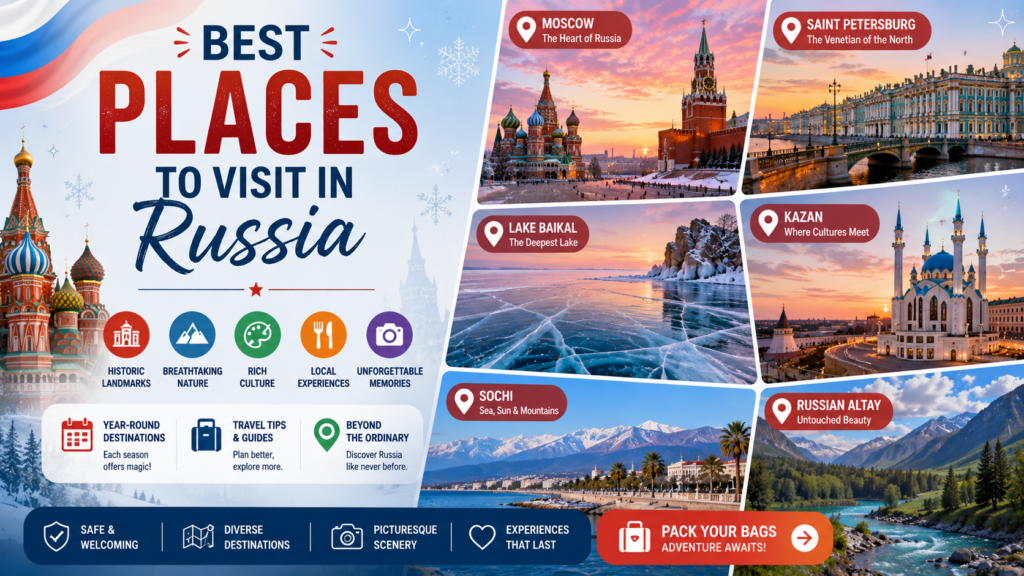
Top Places to Visit in Russia: Quick Overview
| Destination | Region | Best For | Best Time to Visit |
| Moscow | Central Russia | History, architecture, culture | May–Sept, Dec |
| St. Petersburg | Northwest | Art, palaces, White Nights | May–July |
| Golden Ring | Central Russia | Medieval history, monasteries | May–Sept |
| Lake Baikal | Siberia | Nature, scenery, adventure | July–Aug, Jan–Feb |
| Kazan | Volga Region | Culture, food, architecture | May–Sept |
| Trans-Siberian Railway | Russia-wide | Epic journey, landscapes | May–September |
Moscow: One of the Most Famous Places in Russia for History and Architecture
Moscow sits at the top of every places to visit in Russia list, and it earns that position through sheer scale and historical weight. The Russian capital is one of the largest cities in Europe, and its most significant landmarks are concentrated in a surprisingly walkable central core around the Kremlin and Red Square.
- Red Square is the single most important of all Russia famous places. A vast cobblestoned plaza framed by the Kremlin walls on one side, the GUM department store (a 19th-century glass-roofed arcade) on the other, and the extraordinary St. Basil’s Cathedral at the southern end. Built between 1555 and 1561 on the orders of Ivan the Terrible to commemorate a military victory, St. Basil’s multicoloured onion domes are the most recognizable architectural image in Russia and genuinely more extraordinary in person than any photograph prepares you for.
- The Kremlin is the most important of all the famous places of Russia for its historical depth. The fortified complex of cathedrals, palaces, and government buildings at the heart of Moscow. The Armoury Museum within the Kremlin holds the Russian imperial crown jewels, Fabergé eggs, and centuries of royal regalia. The Ivan the Great Bell Tower gives the best panoramic view over the Kremlin complex and the Moscow River.
- The Moscow Metro is one of the most spectacular urban transport systems in the world. Many of the stations built during the Stalin era are decorated with chandeliers, mosaics, marble columns, and bas-relief sculptures to a standard that makes genuine Russia famous places attractions in their own right. Komsomolskaya, Mayakovskaya, and Kievskaya stations are the most celebrated stops on what Russians call “the underground palace.”
- The Tretyakov Gallery houses the finest collection of Russian art in the world, covering icon painting from the 11th century through the Wanderers movement and early 20th-century Russian avant-garde. It’s one of the most important tourist destinations in Russia for art and cultural history, and criminally underknown outside the country.
St. Petersburg: Best Places to Visit in Russia for Art, Palaces and Culture
St. Petersburg is the most visually spectacular of all the famous places in Russia. A European baroque city built from scratch by Peter the Great in 1703 on the marshy delta of the Neva River, designed to give Russia a “window to Europe” and executed with an architectural ambition that produced one of the finest city centres in the world.
- The State Hermitage Museum is the reason most international visitors come to St. Petersburg specifically, and it justifies every superlative applied to it. Housed across six buildings including the Winter Palace (the former official residence of the Russian emperors), the Hermitage holds one of the largest art collections in the world, over three million objects spanning ancient Egypt, classical antiquity, Renaissance masters, and Impressionism. Rembrandt, Leonardo, Raphael, Michelangelo, Picasso, and Matisse are all represented in depth. Allow two full days minimum and buy tickets online well in advance.
- Peterhof Palace (30km west of the city on the Gulf of Finland) is one of the best places to visit in Russia for an imperial experience outside the Hermitage. Known as the Russian Versailles, Peterhof’s Grand Cascade (64 fountains and 255 bronze statues cascading down a hillside to the sea) is one of the most spectacular garden compositions in Europe. The palace interiors rival anything in Western Europe for gilded excess.
- The Church of the Saviour on Spilled Blood — built on the spot where Tsar Alexander II was assassinated in 1881, its interior covered floor to ceiling in approximately 7,500 square metres of mosaic. It is the most distinctive building in St. Petersburg and one of the great tourist destinations in Russia for its architectural and artistic impact.
- White Nights is the most atmospheric time to visit. It is the period from late May through July when St. Petersburg’s northern latitude keeps the sky light around the clock. The city takes on a dreamlike quality, outdoor festivals run continuously, and the Hermitage and Peterhof are at their most popular. Book accommodation months in advance for June.
Golden Ring: Historic Places to Go in Russia for Medieval Architecture
The Golden Ring is a collection of historic towns northeast of Moscow, including Sergiev Posad, Suzdal, Vladimir, Yaroslavl, and several others, that preserve medieval Russian architecture, Orthodox monasteries, and Kremlin complexes largely unchanged from the pre-Petrine era. They represent the places to go in Russia that reveal the country’s deepest historical roots.
- Suzdal is the most complete and a small town of 10,000 people with more than 50 churches, five monasteries, and a kremlin, all within a landscape of meadows and river bends that has barely changed in centuries. The Suzdal Kremlin and the Spaso-Yevfimiev Monastery are the two headline sites, but simply walking between the churches and through the market square gives a sense of medieval Russian life that no city can replicate.
- Sergiev Posad, one hour north of Moscow, has the Trinity Lavra of St. Sergius, the most important monastery in Russia and one of the great Orthodox pilgrimage sites in the world. The blue-and-gold domes of the Assumption Cathedral and the white walls of the monastery complex are among the most recognizable and famous places of Russia outside Moscow and St. Petersburg.
Lake Baikal: Natural Places to Go to in Russia for Scenery and Adventure
Lake Baikal in Siberia is one of the most extraordinary natural places to go to in Russia. It is the world’s deepest lake (1,642 metres at its deepest point), oldest lake (25 million years), and the single largest freshwater body on earth by volume, containing approximately 20% of the world’s unfrozen surface fresh water.
- Olkhon Island in the centre of the lake is one of the most visited places to visit in Russia, a natural destination in Siberia. It is a large island with a small village (Khuzhir), dramatic clifftop views, and the sacred Shamanka Rock (Burkhan Cape) that has been a place of spiritual significance for the indigenous Buryat people for centuries.
- Best time to visit: Summer (July and August) is the warmest and most accessible time, as lake swimming is possible, hiking trails are open, and boat trips around the island are excellent. Winter (January and February) offers a completely different experience the lake freezes to a depth of over a metre, creating a vast transparent ice surface that locals cross by car, hovercraft, and on foot. Ice diving beneath the frozen surface in the extraordinary blue light that filters through is one of the most unusual and best places to visit in Russia.
Kazan: Unique Tourist Destinations in Russia with Cultural Diversity
Kazan, capital of the Republic of Tatarstan on the Volga River, is one of the most culturally distinctive tourist destinations in Russia. It is a city where Orthodox Christianity and Islam have coexisted for five centuries, producing a unique architectural and cultural landscape unlike anywhere else in the country.
- The Kazan Kremlin is a UNESCO World Heritage Site. It contains both the Annunciation Cathedral (Orthodox, 16th century) and the Kul Sharif Mosque (one of the largest mosques in Russia, rebuilt in 2005 on the site of the original destroyed by Ivan the Terrible) within the same fortress walls. The visual contrast between the mosque’s blue minarets and the cathedral’s white bell tower within a single fortified enclosure is extraordinary and is the defining image of places to go in Russia beyond the two main cities.
- The Tatar food culture includes echpochmak (triangular meat pastries), chak-chak (deep-fried honey cake), and katyk (fermented milk). It gives Kazan a culinary identity completely distinct from Moscow and St. Petersburg. The city is increasingly visited as a standalone destination and works well as a stop between Moscow and the Ural Mountains on a wider Russian itinerary.
Trans-Siberian Railway: One of the Best Places to Visit in Russia for Travel Experiences
The Trans-Siberian Railway (running 9,289km from Moscow to Vladivostok across eight time zones) is the most epic of all places to go to in Russia for travel experiences and one of the greatest journeys in the world. The full journey takes approximately seven days non-stop, passing through the Ural Mountains, the West Siberian Plain, the forests and rivers of eastern Siberia, and the mountains above Lake Baikal before descending to the Pacific coast.
Most travellers do the journey in the following segments:
- Moscow to Yekaterinburg (gateway to the Urals)
- Yekaterinburg to Irkutsk (gateway to Lake Baikal)
- Irkutsk onward to Vladivostok or across to Beijing via the Trans-Mongolian branch through Ulaanbaatar.
Each segment gives a completely different landscape, and the cumulative effect is genuinely unlike any other travel experience.
Best time to visit: May through September is the best window for the Trans-Siberian — long daylight hours mean the landscape is always visible, temperatures at stop-off points are comfortable, and Lake Baikal is accessible for swimming and hiking.
Russia Travel Guide: Visa, Budget, and Getting Around
- Visa: Most nationalities require a visa to visit Russia. Apply through the Russian embassy in your country well in advance. The e-visa system covering certain regions has expanded in recent years, but check current requirements carefully before planning.
- Getting around: Russia’s domestic flight network is extensive Aeroflot and S7 Airlines connect Moscow and St. Petersburg to regional cities efficiently. The overnight train between Moscow and St. Petersburg (Sapsan high-speed train, 4 hours, or overnight sleeper) is the classic and most enjoyable connection between the two cities.
- Best time to visit: May through September for the most famous places of Russia, as destinations are warm across the country, long days in St. Petersburg, and outdoor activities are viable everywhere. December is worth considering for Moscow’s extraordinary Christmas decorations and winter atmosphere around Red Square.
- Budget: Russia is affordable by European standards. Mid-range accommodation in Moscow and St. Petersburg runs €40–100 per night. A full meal at a good restaurant costs €10–20. Museum entry (Hermitage, Tretyakov, Kremlin) runs €10–20 per site.
Best Time to Visit Russia for Different Travel Experiences
The best time to visit Russia depends on the kind of experience you’re planning.
- May to September is the most popular season, with warm weather, long daylight hours, and full access to major tourist destinations in Russia, including Moscow, St. Petersburg, and the Golden Ring.
- June and July are ideal for experiencing the White Nights in St. Petersburg.
- For winter travel, December to February offers snow-covered cities, festive markets, and a dramatic Moscow experience, though temperatures can be extreme.
- Choose summer for sightseeing and landscapes, or winter for atmosphere and fewer crowds.
Plan your trip based on whether you prioritize comfortable weather, unique seasonal experiences, or fewer crowds.
Best Places to Visit in Russia by Itinerary
Planning your trip by duration makes it easier to prioritize the best places to visit in Russia.
- A 7-day itinerary typically covers Moscow and St. Petersburg, including major landmarks like the Kremlin, Red Square, and the Hermitage.
- Within 10 days, you can add the Golden Ring or Kazan for deeper cultural insight.
- A 14-day trip allows for a more immersive experience, including Lake Baikal or a segment of the Trans-Siberian Railway.
Choose your itinerary based on how much time you want to spend exploring beyond the time you want to spend exploring beyond the main tourist destinations in Russia.
Frequently Asked Questions
Red Square and the Kremlin in Moscow, the Hermitage Museum and Peterhof in St. Petersburg, Lake Baikal in Siberia, and the Golden Ring monasteries are the famous places in Russia most consistently ranked as the country’s greatest travel experiences.
Two weeks covers Moscow (4 nights), the Golden Ring day trips (1–2 nights in Suzdal), St. Petersburg (4 nights), and a side trip to Peterhof. Add a week for Lake Baikal or Kazan on a longer itinerary. The Trans-Siberian warrants a dedicated trip of three to four weeks.
The Kremlin and St. Basil’s Cathedral, the Hermitage Museum, Peter of Palace, Lake Baikal, and the Trans-Siberian Railway are the five experiences Russia is most internationally associated with, all genuinely extraordinary and fully justifying the logistical effort of visiting.
Russia delivers some of the most architecturally and culturally significant tourist destinations in Russia at relatively low cost. The Hermitage alone is a credible reason to make the trip. The logistical complexity (visa, language barrier, distance) is real but manageable with advance planning.
May to September is the best overall window as it is warm across the country, White Nights in St. Petersburg from late May through July, and outdoor sites are fully accessible. December is excellent, specifically for Moscow’s winter atmosphere and Christmas markets around Red Square.