

The best scuba diving destinations in the world are concentrated in tropical waters between the Tropic of Cancer and the Tropic of Capricorn, where water temperatures, coral reef health, and marine biodiversity align to create conditions that no temperate-water diving can match. From the hyper-biodiverse reefs of Indonesia to the legendary wrecks of the Pacific and the wall dives of the Red Sea, the best places to dive in the world cover an extraordinary range of underwater experiences. Here’s where serious divers and those just getting certified should be looking.
Best Places to Go Scuba Diving in the World (Quick List)
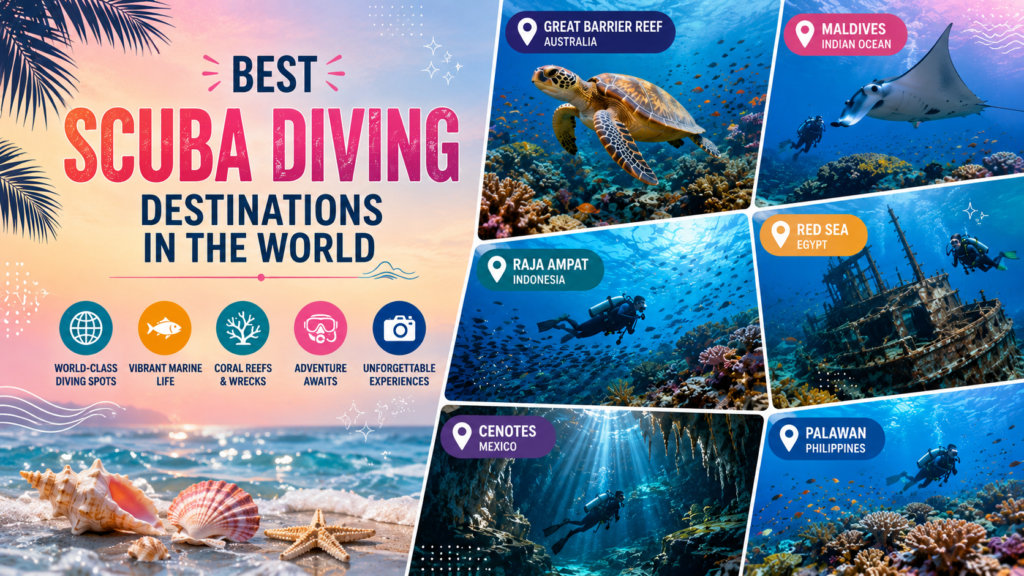
| Destination | Country | Best For | Best Time to Dive |
| Raja Ampat | Indonesia | Biodiversity, soft corals, reefs | Oct–April |
| Great Barrier Reef | Australia | Scale, variety, marine life | June–October |
| Palau | Micronesia | Wrecks, jellyfish lake, sharks | Nov–April |
| Maldives | Indian Ocean | Mantas, whale sharks, atolls | Nov–April |
| Coron | Philippines | WWII wrecks, lakes | Dec–May |
| Red Sea | Egypt | Reefs, wrecks, visibility | Year-round |
| Galápagos | Ecuador | Hammerheads, whale sharks | June–November |
| Belize | Caribbean | Blue Hole, wall dives | Nov–May |
Raja Ampat: The Best Scuba Diving Destination in the World
Raja Ampat in West Papua, Indonesia, is the consensus answer to the question of the best place to scuba dive on the planet, and marine biology supports that claim without exaggeration. Situated at the heart of the Coral Triangle, Raja Ampat contains over 75% of the world’s known coral species and more fish species per square kilometre than any other measured marine environment on earth.
- The diving here is extraordinary at every level. The drift dives through channels filled with soft corals in colours that look artificially saturated, walls dropping hundreds of metres into blue water, and reef systems teeming with pygmy seahorses, wobbegong sharks, walking epaulette sharks, and the extraordinary variety of nudibranchs that make the region a macro photography paradise.
- Misool, in the south of the archipelago, has the densest concentration of soft corals. The underwater seascape at sites like Magic Mountain and the Misool reef system is the most visually overwhelming diving in the world.
- Wayag in the north has the iconic karst island scenery above water and excellent reef diving below.
- Dampier Strait between Sorong and Waigeo Island has strong currents that aggregate large pelagics — manta rays at Manta Sandy and Manta Ridge are reliable year-round.
Best time to visit: October to April is the best diving window with calmer seas and better visibility.
How to get there: Getting there requires flying to Sorong and transferring by speedboat or liveaboard. The logistics require planning, but the reward is unmatched by any other destination on this list.
Great Barrier Reef: One of the Best Places to Dive in the World
The Great Barrier Reef off Queensland, Australia, is the largest coral reef system in the world — 2,300km of reef structures, 900 islands, and 3,000 individual reef systems covering an area larger than the United Kingdom. It’s one of the best diving destinations in the world for sheer scale and variety; no single dive trip covers more than a fraction of it.
- Cod Hole near Lizard Island in the far north is famous for its resident potato cod with enormous groupers that approach divers with disconcerting confidence.
- Osprey Reef in the Coral Sea, accessible by liveaboard, has vertical wall dives dropping into 1,000-metre depths with hammerhead sharks and grey reef sharks patrolling the edge.
- The Ribbon Reefs have consistently excellent visibility and some of the most intact coral structures on the reef.
Best time to visit: June to October is the best diving season with visibility at its clearest, water temperatures are comfortable at 23–26°C, and the Great Barrier Reef’s famous dwarf minke whales are present in the northern sections from June through July.
Palau: A Top Scuba Location in the World for Variety
Palau in Micronesia consistently ranks among the best scuba places in the world for the sheer variety of experiences packed into a relatively compact dive area. The country sits at the intersection of three ocean currents, creating exceptional nutrient upwelling that feeds reef systems of outstanding health and density.
- Blue Corner is Palau’s most famous dive site with a reef edge jutting into open ocean where strong currents aggregate sharks, barracuda, Napoleon wrasse, and eagle rays in concentrations that are genuinely overwhelming. Divers hook into the reef wall to stay stationary while the marine life circles — one of the most exhilarating best scuba locations in the world.
- Jellyfish Lake (Ongeim’l Tketau) is a landlocked marine lake filled with millions of golden jellyfish that have evolved without stingers, and is one of the most unique snorkelling and diving experiences in the world.
- The WWII wrecks of Chuuk Lagoon (technically Micronesia rather than Palau but accessible on the same liveaboard circuit) include over 60 Japanese ships sunk in Operation Hailstone, which is the largest collection of diveable WWII wrecks in the world.
Maldives: One of the Best Scuba Destinations in the World for Mantas
The Maldives is one of the best scuba destinations in the world for pelagic marine encounters and specifically manta rays and whale sharks, both present in numbers that no other easily accessible destination consistently matches.
- Hanifaru Bay in the Baa Atoll UNESCO Biosphere Reserve is the most important manta ray feeding aggregation site in the Indian Ocean. Up to 200 mantas feeding simultaneously in a small bay during the southwest monsoon (June to November) creates one of the most spectacular wildlife encounters available to any diver or snorkeller.
- South Ari Atoll has the most reliable whale shark sightings year-round. The gentle giants congregate around the atoll’s reef edges in numbers that make encounters on most dives practically guaranteed.
- The reef diving throughout the Maldives atolls — thilas (submerged reef pinnacles) draped in soft corals, overhangs, and channels swept by currents carrying grey reef sharks and eagle rays — is world-class throughout the archipelago.
Best time to visit Maldives: November through April (dry season) gives the best visibility and calmest conditions for the best places to go scuba diving in the world.
Planning a Maldives diving trip? Finding coupons for flights well in advance makes a significant difference to the overall budget.
Coron, Philippines: Best Place to Scuba Dive for Wrecks
Coron in Palawan, Philippines, is the best places to scuba for wreck diving, specifically, a sheltered bay containing 12 Japanese warships sunk by American aircraft in September 1944, all lying at recreational diving depths between 10 and 40 metres.
- The Okikawa Maru (the largest wreck at 170 metres), the Irako (a refrigeration ship with intact interior rooms), and the Kogyo Maru (a cargo vessel with trucks still chained to the deck) are the three headline dives. All have been colonized by extraordinary marine growth, sea fans, soft corals, and schooling fish, turning what are essentially war graves into vibrant artificial reefs.
- The Barracuda Lake above Coron town — a landlocked lake with a thermocline between cold freshwater and warm saltwater visible as an underwater shimmer — is one of the most unusual dive experiences in Southeast Asia. Our full guide to the best places to visit in the Philippines covers Coron alongside the rest of Palawan in detail.
Red Sea, Egypt: Best Scuba Diving Destination for Beginners & Budget
Egypt’s Red Sea coast is the most accessible of all the best scuba locations in the world for European divers with short flights, year-round warm water (22–28°C), and some of the clearest visibility in the world (30–40 metres on good days), making it the entry point for millions of first-time and returning divers annually.
- Ras Mohammed National Park at the southern tip of the Sinai Peninsula has wall dives dropping into 800-metre depths with schooling barracuda, jackfish, and reef sharks.
- SS Thistlegorm is a British WWII cargo ship sunk in 1941, carrying motorcycles, trucks, ammunition, and railway cars. It is one of the most celebrated wreck dives in the world and regularly cited as one of the best diving destinations in the world for accessibility and content.
- The Brothers and Daedalus Reef in the southern Egyptian Red Sea, accessible by liveaboard, have oceanic whitetip sharks and thresher sharks on regular rotation — genuinely pelagic diving in an approachable format.
The Red Sea’s combination of quality, accessibility, and price makes it the best scuba destinations in the world for divers working within budget constraints. Look for the best hotel deals in Hurghada and Sharm el-Sheikh, as both resort towns have a wide range of accommodation options that bundle dive packages at very competitive rates.
Galápagos Islands: Best Diving Destination in the World for Advanced Divers
The Galápagos Islands in Ecuador are the best places to go scuba diving in the world for sheer concentration of large pelagic marine life. But they are not a destination for beginners. Strong, unpredictable currents, cold water (18–24°C depending on season), and exposed dive sites require experience and solid buoyancy control.
What the Galápagos delivers in exchange is extraordinary:
- Hammerhead shark schools at Darwin and Wolf Islands, numbering in the hundreds, whale sharks (the largest individuals recorded anywhere in the world — pregnant females congregate here),
- Galápagos sea lions playing with divers underwater, marine iguanas grazing on algae at depth, and mola mola (ocean sunfish) cleaning stations.
- Darwin Island’s The Arch is the single most celebrated dive site in the Galápagos. A submerged rock arch in the open ocean where whale sharks, hammerheads, and silky sharks congregate in numbers available nowhere else on earth. June through November (cool Humboldt Current season) is the best window for large pelagic encounters.
Belize: One of the Best Scuba Places in the World for Unique Dive Sites
Belize’s Great Blue Hole — a 300-metre wide, 125-metre deep submarine sinkhole in the centre of the Lighthouse Reef atoll — is the most iconic single dive site in the Caribbean and one of the most recognizable scuba places in the world.
- The dive itself descends to 40 metres through crystal clear water into the stalactite formations of what was once a dry limestone cave, now submerged. Bull sharks and Caribbean reef sharks circle at depth. The geological formations — enormous stalactites hanging at 30–40 metres — are extraordinary evidence of ancient sea level changes.
- The surrounding Belize Barrier Reef is the second-largest in the world after the Great Barrier Reef, and it has outstanding reef diving throughout its length.
- Half Moon Caye Wall near the Blue Hole is one of the Caribbean’s best wall dives, with a resident colony of red-footed boobies nesting above the waterline and magnificent frigate birds overhead.
Best time to visit: November through May is the best diving window — clearest visibility and calmest sea conditions on the outer atolls.
Scuba Diving Travel Guide: Tips, Certification & Planning
- Certification: PADI Open Water or equivalent is the minimum for most recreational dive sites. Advanced Open Water opens up deeper sites (Galápagos, Blue Hole, Red Sea walls). A divemaster or guided dive is required at several protected sites (Hanifaru Bay, Galápagos).
- Liveaboards vs resort diving: For remote sites (Raja Ampat, Galápagos, Palau’s outer reefs), liveaboards are the only practical option and give access to sites that day boats can’t reach. For Red Sea, Philippines, and Maldives resort diving, both options work well.
- Equipment: Most destinations rent quality equipment — bringing your own mask, fins, and wetsuit guarantees fit and hygiene. Full equipment rental adds €15–40 per day, depending on destination.
- Travel insurance: Dive-specific insurance (DAN — Divers Alert Network) is essential — standard travel insurance excludes diving-related injuries, including decompression sickness treatment.
- Booking flights early: Liveaboard itineraries often require specific arrival airports in small island nations; book flights as soon as the liveaboard is confirmed. Finding coupons for flights to remote dive destinations like Sorong (Raja Ampat), Koror (Palau), and Malé (Maldives) well in advance gives the best fare options.
Frequently Asked Questions
Raja Ampat in Indonesia is the most consistently cited best place to scuba dive globally. The marine biodiversity is unmatched by any measured site, and the diving across the archipelago covers every style from drift to macro to pelagic.
The Red Sea (Egypt) and the Maldives are the strongest options for less experienced divers for warm, clear water, calm conditions at most sites, and excellent dive instructor infrastructure. The Great Barrier Reef (outer reefs from Cairns) is a strong third option.
Coron (Philippines), Chuuk Lagoon (Micronesia), and the Red Sea (SS Thistlegorm) are the three best scuba destinations in the world for wreck diving specifically. All three have WWII-era wrecks at recreational depths with extraordinary marine growth.
November through April is the northeast monsoon dry season. It gives the best visibility and calmest conditions across the Maldives atolls. Hanifaru Bay manta aggregations peak during the southwest monsoon (June to November) and require a separate trip timing if mantas are the priority.
Basic swimming ability is required for Open Water certification — you need to be comfortable in the water, able to swim 200 metres unaided, and float for 10 minutes. You don’t need to be a competitive swimmer. The buoyancy control skills that matter most in diving are taught during the certification course itself.