
When is the best time to visit the Maldives comes down to one straightforward answer November to April, during the northeast monsoon dry season, when rainfall is minimal, seas are calm, and the water clarity that makes the Maldives one of the world’s great dive and snorkel destinations is at its absolute peak. That said, the Maldives rainy season is considerably more nuanced than the word “rainy” implies and understanding both seasons properly opens up travel windows that most visitors overlook.
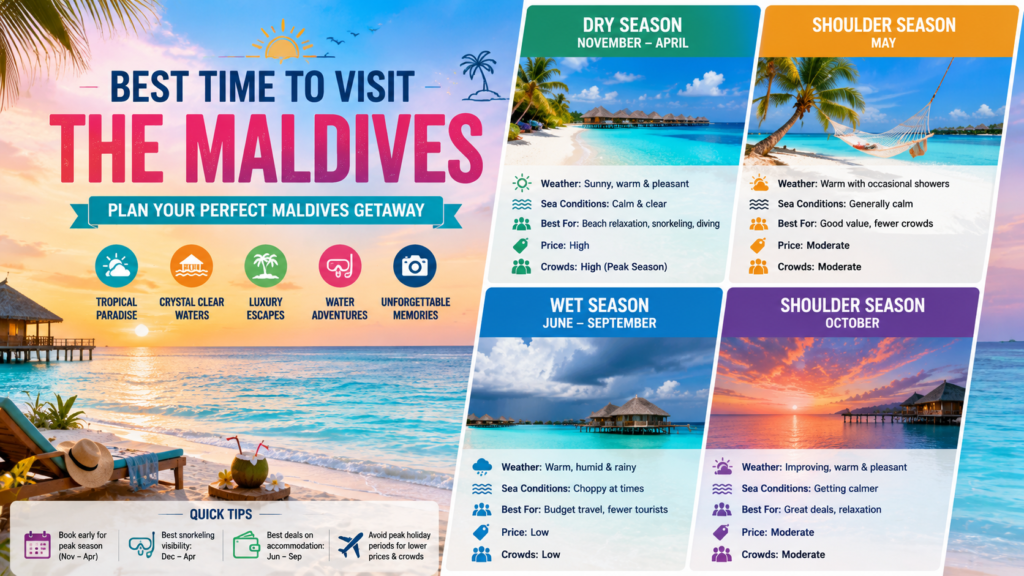
Best Time to Visit the Maldives (Quick overview)
The best time to visit the Maldives is from November to April, during the dry season, when the weather is sunny, the seas are calm, and visibility is at its best. For budget travel and manta rays, May to October can also be a good option. Here’s the quick breakdown.
| Month | Season | Weather | Diving Visibility | Best For |
| January | Dry | Sunny, 28–30°C | Excellent | Everything — peak conditions |
| February | Dry | Sunny, 28–30°C | Excellent | Peak season, whale sharks |
| March | Dry (easing) | Mostly sunny, 29–31°C | Very good | Mantas, warm water |
| April | Transitional | Warm, some cloud | Good | Value, fewer crowds |
| May | Wet begins | Humid, showers | Moderate | Budget travel, mantas |
| June | Wet | Rain, swells | Moderate | Hanifaru Bay mantas |
| July | Wet | Rain, rough seas | Moderate | Manta aggregations |
| August | Wet | Rain, rough seas | Moderate | Manta aggregations |
| September | Wet | Rain easing | Improving | Budget, quieter |
| October | Transitional | Mixed, improving | Good | Value, shoulder season |
| November | Dry begins | Mostly sunny, 28–30°C | Very good | Whale sharks return |
| December | Dry | Sunny, 28–30°C | Excellent | Peak season, festive |
Maldives Best Time to Go: Dry Season vs Monsoon Explained
The Maldives sits just north and south of the equator, which means temperatures stay consistently warm year-round at 28–31°C regardless of season. Unlike destinations where season changes mean dramatic temperature swings, when to visit Maldives is determined almost entirely by rainfall, wind direction, and sea conditions rather than temperature.
- The northeast monsoon (Iruvai) runs from approximately November through April — bringing dry, settled weather from the northeast with calm seas and clear skies across the atolls. This is the dry season, and the Maldives best time to go window shopping for most visitors.
- The southwest monsoon (Hulhangu) — the Maldives monsoon period — runs from May through October, bringing moisture-laden winds from the southwest with increased rainfall, choppier seas, and reduced visibility. However, this season also brings the nutrient upwelling that feeds the plankton concentrations that attract the Maldives’ extraordinary manta ray aggregations — creating the paradox of the “worst” weather season also producing some of the best wildlife encounters.
Best Time to Travel to Maldives (November to April)
The best time to travel to Maldives for the majority of visitors is firmly within the November to April dry season window — and the reasons are consistent across every type of Maldives trip.
- Sea conditions are calm throughout the atolls — the flat, protected lagoons around most resort islands are glassy and swimmable without exception. Speedboat and seaplane transfers between atolls are smooth and reliable. Outdoor activities — snorkelling from the villa steps, paddleboarding, kayaking, sunset cruises — are all dependably operational.
- Water visibility is at its annual best during the dry season — 20–40 metres on good days across most atolls, with the particularly clear water of the outer atoll channels reaching 40+ metres. For snorkellers and divers, this visibility transforms the experience — coral formations, reef fish, and passing pelagics are visible at distances that the wet season’s plankton-heavy water reduces significantly.
- Weather reliability is the defining feature; dry season days typically follow a pattern of clear sunrise, blue-sky mornings, and calm warm evenings with very occasional brief afternoon showers. The consistency that justifies the Maldives’ price point is at its most dependable during this window.
Best Month to Visit Maldives in the Dry Season
Within the November to April window, the best month to visit Maldives depends on specific priorities:
- January and February are the peak of peak season, the driest months, the clearest water, and the best overall conditions across every activity. Whale sharks are present in the South Ari Atoll with high sighting frequency. Accommodation prices are at their annual highest, and advance booking is essential for popular overwater villa properties. For honeymooners and first-time visitors who want guaranteed conditions, this is when is the best time to visit the Maldives is answered most simply.
- December combines excellent dry season conditions with the festive atmosphere of Christmas and New Year. It is the most expensive booking window of the entire year. Resorts fill completely for the Christmas week, and prices spike dramatically. Book 9–12 months in advance for December travel and expect premium rates across every property category.
- March is the warmest month. Water temperatures reach 30–31°C, visibility remains excellent, and the northeast monsoon begins its gradual transition. Late March sees the first signs of the shift toward the wet season with occasional cloud build-up and a marginal increase in humidity, but conditions remain very good for most of the month.
- November is the most underrated month in the dry season — conditions are excellent, the wet season has cleared, and the post-October quiet means prices are below January and February peaks. Whale sharks return to South Ari Atoll in November, and manta activity continues from the wet season. It’s the best time to go Maldives for value-conscious travellers who still want dry season conditions.
Maldives Rainy Season (May to October): What to Expect
The Maldives rainy season does not mean continuous rain. The typical wet season pattern is a mix of sunny spells, overcast periods, and rain squalls that move through quickly — rarely the sustained all-day downpours that the word “monsoon” implies to most travellers. Many wet season visitors have predominantly sunny days with brief afternoon showers, particularly in May and October at the shoulders of the season.
When Is the Best Season to Visit Maldives on a Budget?
When is the best season to visit Maldives if you’re on a tighter budget? The wet season (May through October) offers the lowest prices and some specific wildlife advantages — but requires honest expectation management. What genuinely changes during the wet season:
- Sea conditions — swells and choppier water make speedboat transfers less comfortable, some exposed dive sites inaccessible, and water sports less reliable. Seaplane operations are weather-dependent, and delays are more frequent.
- Visibility — plankton blooms that characterize the wet season reduce underwater visibility to 5–15 metres in many locations, compared to 20–40 metres in the dry season. For diving and snorkelling specifically, this is the most significant practical difference.
- Prices — wet season rates at most Maldives resorts are 30–50% lower than peak dry season, making properties that are financially out of reach in January accessible in June or September. Local guesthouses on inhabited islands drop to genuinely budget-friendly levels.
Maldives Monsoon Period: Manta Rays & Wildlife Season
The Maldives monsoon period has one extraordinary compensation for its weather compromises: the manta ray aggregations at Hanifaru Bay in the Baa Atoll UNESCO Biosphere Reserve.
The southwest monsoon drives plankton-rich water into Hanifaru Bay between June and November — concentrating food sources that attract manta rays in aggregation numbers that are simply unmatched anywhere else in the Indian Ocean. Up to 200 mantas feeding simultaneously in a small bay is the peak experience — a wildlife spectacle with no equivalent in the region. July and August represent the peak of the aggregation season, with September and October also producing excellent encounters.
This creates a genuine planning decision: when is the best time to go to the Maldives if manta rays are the priority, is a different answer (June–November, Baa Atoll) from when is the best time to visit the Maldives for general resort conditions (November–April).
Whale sharks in South Ari Atoll are present year-round but most reliably from November through April — peak dry season aligns with peak whale shark activity, making the dry season the stronger window for combining both pelagic species in a single trip.
Best Time to Go Maldives by Activity (Diving, Honeymoon, Surfing)
| Activity | Best Months |
| Whale shark encounters (South Ari Atoll) | November–April |
| Manta ray aggregations (Hanifaru Bay) | June–November (peak July–August) |
| Diving — best visibility | December–March |
| Snorkelling from villa/beach | November–April |
| Water sports (surfing, kitesurfing) | May–October (consistent swells) |
| Budget travel | May–October |
| Honeymoon (best conditions) | January–February, November |
| Surfing (North Male, Lhaviyani Atolls) | June–September |
| Avoiding peak crowds | April–May, October–November |
When to Visit Maldives: Peak vs Shoulder Season Guide
The honest answer to when to visit Maldives on a budget is the shoulder months — April, October, and November — which give the best compromise between dry season conditions and below-peak pricing.
- April is transitioning from dry to wet — conditions are still mostly good, prices drop from February and March peaks, and crowds thin noticeably. The first weeks of April are often excellent. Late April sees the wet season beginning to establish — flexibility in travel dates helps.
- October is the reverse transition — the wet season is easing, conditions are improving week by week through the month, and prices remain well below the December to March peak. Early October can still be unsettled; late October is often very close to dry season quality at wet season prices.
- November is the strongest shoulder recommendation: genuine dry season conditions, fully returned visibility and calm seas, and prices that are 20–30% below the January and February peak before the December festive spike arrives.
For the full picture on planning a Maldives trip within a broader Asia itinerary, our guides on the best Asian countries to travel to and the best places to visit in December give useful context on combining the Maldives with surrounding destinations.
Frequently Asked Questions
November through April is the best time to travel to Maldives for most visitors — dry, calm, and clear across all atolls. January and February are the peak of conditions. November is the best value within the dry season window.
The Maldives rainy season runs from May through October, driven by the southwest monsoon. June, July, and August are the wettest and most unsettled months. The rain typically comes in squalls rather than sustained downpours — many wet season visits have predominantly sunny weather with brief rain periods.
Yes, specifically for the manta ray aggregations at Hanifaru Bay (June–November), significantly lower prices across all resort categories, and a quieter, less crowded atmosphere. The trade-offs in visibility and sea conditions are real but manageable for visitors whose priority is mantas or budget.
December through March gives the best diving conditions — clearest visibility, calmest seas for liveaboard access to outer atoll sites, and whale sharks reliably present in South Ari Atoll. November is a strong alternative with improving conditions and slightly lower prices.
For the Christmas and New Year window — 9–12 months. For January and February, peak season 6–9 months for overwater villa properties, which are the first to sell out. November and shoulder season months can be booked 3–4 months out with reasonable availability.