
Things to do in Tokyo Japan span an almost impossible range for a single city — ancient Buddhist temples next to neon-lit entertainment districts, Michelin-starred ramen shops, world-class art museums, and neighbourhoods so distinct from each other they feel like separate cities entirely.
Tokyo is consistently rated one of the greatest cities in the world. Here’s why and exactly where to spend your time.
Top Things to Do in Tokyo at a Glance
| Area / Attraction | Best For | Neighbourhood | Cost |
| Senso-ji Temple | History, atmosphere, markets | Asakusa | Free |
| Shibuya Crossing | Iconic Tokyo experience | Shibuya | Free |
| Shinjuku Gyoen | Gardens, cherry blossoms | Shinjuku | ¥500 |
| teamLab Borderless | Digital art, immersive experience | Azabudai Hills | ¥3,200 |
| Tsukiji Outer Market | Street food, sushi breakfast | Tsukiji | Free entry |
| Meiji Shrine | Shinto culture, forested walks | Harajuku | Free |
| Tokyo Skytree | City panorama, views | Asakusa | ¥2,100+ |
| Akihabara | Electronics, anime, pop culture | Akihabara | Free to browse |
Best Things to Do in Tokyo, Japan
Senso-ji Temple & Asakusa – Best for History and Culture
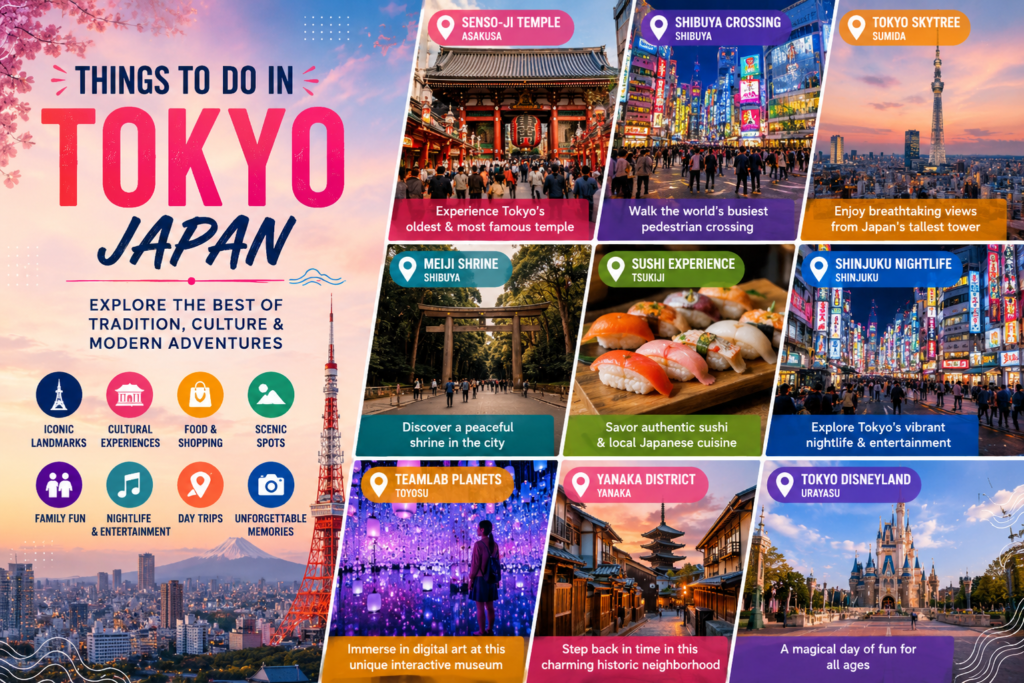
Senso-ji in the Asakusa district is Tokyo’s oldest temple and one of the most important Tokyo attractions — a Buddhist temple complex founded in 628 AD, rebuilt after WWII bombing, and still one of the most visited religious sites in Japan.
What makes it unmissable:
- The Kaminarimon Gate (Thunder Gate) with its enormous red paper lantern is the most photographed image in Tokyo
- Nakamise Shopping Street — the 200-metre covered lane leading to the temple, lined with vendors selling traditional snacks, fans, and souvenirs — is the best souvenir street in the city
- The main hall (Hondo) is extraordinary at dawn — arrive before 7am when the temple belongs entirely to worshippers and the atmosphere is genuinely reverent
Asakusa neighbourhood surrounding the temple is the best surviving pocket of old Tokyo — wooden shopfronts, traditional craft shops, and the Hoppy Street outdoor dining strip give the area a character that more commercial districts have lost.
The Tokyo Skytree (634 metres tall, the tallest tower in Japan) is a 10-minute walk from Senso-ji. The observation decks at 350 and 450 metres give the best panoramic views over the city, making it one of the best things to do in Tokyo. Book tickets in advance online to skip the queues.
Shibuya – Most Iconic Tokyo Experience
Shibuya is where the places to visit in Tokyo list gets most iconic — the Shibuya Scramble Crossing is the busiest pedestrian intersection in the world, with up to 3,000 people crossing simultaneously when the lights change.
Don’t just cross it — watch it first. The best viewing points:
- Starbucks second floor (free, just buy a coffee) — directly above the crossing
- Mag’s Park rooftop — free access, slightly higher angle
- Shibuya Sky observation deck — the best elevated view, ¥2,000
Beyond the crossing, Shibuya has excellent street food, some of Tokyo’s best independent clothing stores in the backstreets of Shimokitazawa (20 minutes by train), and the famous Hachiko Statue — the bronze dog commemorating Hachiko’s loyal wait for his owner — directly outside the station.
Daikanyama and Nakameguro, walkable from Shibuya, are the city’s most relaxed and stylish neighbourhoods. The Nakameguro canal lined with cherry trees is one of the most beautiful places to go in Tokyo during cherry blossom season (late March to early April).
Shinjuku – Nightlife, Views and City Energy
Shinjuku is Tokyo at its most intense — and one of the essential places to go in Tokyo for the full sensory experience.
During the day:
Shinjuku Gyoen is one of the finest gardens in Japan — 58 hectares of French formal garden, English landscape garden, and traditional Japanese garden combined. The cherry blossom viewing here (late March to early April) is among the best in Tokyo. Entry ¥500.
The Tokyo Metropolitan Government Building observation deck is free — open most evenings until 10:30 pm — giving one of the best night views of the city without paying for a dedicated observation tower.
After dark:
Kabukicho — Tokyo’s entertainment district — is neon, karaoke, restaurants, and bars in a density that is genuinely overwhelming on first encounter. The Godzilla head emerging from the Toho Cinema building is a favourite Tokyo must see places photo stop.
Golden Gai — a network of tiny alleys with over 200 bars, each seating 6–8 people, tucked behind Kabukicho — is the most atmospheric drinking experience in Tokyo. Each bar has its own theme, its own regular crowd, and its own character. Wander in, pick a bar that appeals, and spend an hour talking to whoever’s there.
Harajuku & Omotesando – Fashion, Food and Culture
Harajuku and its main street Takeshita-dori is the centre of Tokyo’s youth fashion culture — colourful, chaotic, and completely unlike any shopping street in Europe or North America.
Crepe shops, vintage clothing, cosplay accessories, and candy-coloured fashion fill the narrow pedestrian lane in a way that’s worth experiencing even for visitors with no intention of buying anything.
Meiji Shrine — a five-minute walk from Takeshita-dori through a forested approach that feels completely removed from the city — is one of the most important Tokyo attractions for Shinto culture. The 70-hectare forest surrounding the shrine was planted in 1920 and creates an extraordinary sense of natural calm in the middle of one of the world’s densest urban environments.
Omotesando Avenue parallel to Harajuku is Tokyo’s most architecturally interesting shopping street — flagship stores by Tadao Ando, Herzog & de Meuron, and SANAA line the zelkova tree-canopied boulevard. Even without shopping, the architecture is worth a slow walk.
Best Museums and Art Experiences in Tokyo
Tokyo has some of the finest museums in Asia — and several that are genuinely world-class by any measure.
| Museum | Why Go | Cost |
| teamLab Borderless (Azabudai Hills) | Most extraordinary and immersive digital art experience in the world | ¥3,200 |
| Tokyo National Museum (Ueno) | Largest collection of traditional Japanese art and antiquities | ¥1,000 |
| Mori Art Museum (Roppongi Hills) | Best contemporary art views + city panorama | ¥2,000 |
| Edo-Tokyo Museum | History of Tokyo from the Edo period to present | ¥600 |
| Ghibli Museum (Mitaka) | Studio Ghibli animation world, must-visit for Anime Fans — book months ahead | ¥1,000 |
| 21_21 Design Sight (Midtown) | Best design museum in Japan, Tadao Ando building | ¥1,400 |
teamLab Borderless deserves special mention — the reopened version at Azabudai Hills is the most immersive digital art experience available anywhere in the world. Projections cover every surface of a labyrinthine space with no fixed artworks — the environment shifts and responds to visitor movement. Book online well in advance.
The Ghibli Museum in Mitaka (30 minutes west of Shinjuku by train) is one of the most beloved Tokyo must see places for anime fans — tickets are released monthly through Lawson convenience stores and sell out within minutes. Check availability before building your itinerary around it.
Things to Do in Tokyo for Pop Culture Lovers
Akihabara – Anime, Gaming and Electronics Hub
Akihabara is the global centre of anime, manga, gaming, and electronics culture — and one of the best things to do in Tokyo for visitors who want to understand contemporary Japanese popular culture.
What to do here:
- Multi-floor electronics stores (Yodobashi Camera, BIC Camera) selling everything from components to home appliances at prices that are often cheaper than anywhere outside Japan
- Anime and manga shops across multiple floors — new releases, vintage collectibles, figurines, and merchandise covering every series imaginable
- Retro gaming stores selling original Famicom, Super Famicom, and Game Boy cartridges and consoles that are increasingly collectible
- Maid cafés — a distinctly Akihabara institution where servers in maid costumes serve coffee and cake while playing games with customers. Unusual, good-humoured, and worth experiencing once
The neighbourhood is at its most energetic on Sunday afternoons when the main street (Chuo-dori) is closed to traffic and becomes a pedestrian zone.
Best Day Trips From Tokyo Worth Taking
Tokyo’s excellent rail network makes several extraordinary destinations accessible as day trips.
| Destination | Travel Time | Why Go |
| Nikko | 2 hours (Tobu line) | Elaborate shrine complex, waterfalls, mountain scenery |
| Kamakura | 1 hour (JR Yokosuka line) | Giant Buddha, Zen temples, coastal walks |
| Hakone | 1.5 hours (Romancecar) | Mount Fuji views, hot springs, open-air museum |
| Kyoto | 2h15m (Shinkansen) | Best day trip in Japan — temples, geisha districts |
| Yokohama | 30 minutes (JR line) | Chinatown, harbour, Sankeien Garden |
Hakone is the most popular places to go in Tokyo day trip — the combination of Mount Fuji views (weather permitting), the Hakone Open-Air Museum, and a traditional ryokan onsen experience makes it the most complete single-day escape from the city.
Kyoto by Shinkansen is technically possible as a day trip but genuinely better as an overnight — the 2h15m journey each way eats significantly into the day.
Tokyo Must See: Food Experiences You Can’t Skip
Tokyo has more Michelin stars than any city in the world — but the most important food experiences here aren’t in fine dining restaurants.
The essential Tokyo food list:
- Tsukiji Outer Market breakfast — fresh sushi, grilled scallops, and tamagoyaki (sweet rolled omelette) from market stalls, eaten standing, before 9 am
- Ramen — specifically tonkotsu ramen at Ichiran (solo booth dining, genuinely excellent) or tsukemen (dipping ramen) at Fuunji in Shinjuku
- Conveyor belt sushi (kaiten-zushi) — Genki Sushi or Kurazushi for the full automated experience at ¥100–150 per plate
- Convenience store food — Tokyo’s 7-Elevens and FamilyMarts serve genuinely good onigiri, sandwiches, and hot foods. Not a consolation — an experience
- Depachika (department store basement food halls) — Isetan in Shinjuku and Matsuya in Ginza have the best selections of prepared foods, pastries, and bento boxes in the city
Golden Gai for late-night drinks. Omoide Yokocho (Memory Lane) in Shinjuku — a narrow alley of tiny yakitori restaurants with smoke-blackened ceilings and plastic seats — for grilled skewers and cold Sapporo beer at midnight.
Practical Tips for Visiting Tokyo
How to Get Around Tokyo:
- The Tokyo Metro and JR Yamanote Line (the loop line connecting major neighbourhoods) cover virtually every places to visit in Tokyo efficiently
- Get a Suica or Pasmo IC card from any station — a stored value card covering metro, JR, and most buses. Tap in, tap out
- JR Pass covers Shinkansen if you’re travelling to Kyoto, Osaka, or other cities — calculate whether it pays off against point-to-point tickets before buying
Budget and Daily Costs:
- Japan is still largely cash-based — carry yen at all times. ATMs at 7-Eleven and Japan Post accept foreign cards reliably
- Budget ¥2,000–3,000 (€12–18) per day for food if eating at local restaurants and street stalls. Mid-range restaurant meals run ¥1,000–2,500 per person
Where to Stay in Tokyo:
- Shinjuku and Shibuya are the best bases for first-time visitors — central, well-connected, surrounded by everything
- Asakusa suits travellers who want the traditional Tokyo atmosphere at slightly lower hotel prices
- Capsule hotels are a genuinely worthwhile experience — The Prime Pod in Ginza and 9 Hours in Shinjuku are the best options
Best Time to Visit Tokyo:
| Season | Months | Why Visit |
| Cherry Blossom | Late March–Early April | Most beautiful Tokyo experience of the year |
| Autumn Colours | October–November | Foliage in parks and temple gardens |
| Winter | December–February | Crisp and clear, Christmas illuminations, fewer tourists |
| Summer | June–August | Hot (30–35°C) and humid — manageable with AC everywhere |
FAQs About Things to Do in Tokyo
Five to seven days cover the essential things to do in Tokyo Japan comfortably, main neighbourhoods, two or three museums, one or two day trips, and enough time to eat well without rushing. Three days work for a focused first visit to the highlights only.
Senso-ji Temple, Shibuya Crossing, Shinjuku (Gyoen by day, Golden Gai by night), teamLab Borderless, and a Tsukiji breakfast are the five Tokyo must see places that most comprehensively capture what makes the city extraordinary.
Less than its reputation suggests. Transport is efficient and affordable, street food and convenience store meals cost very little, and many of the best Tokyo attractions — temples, shrine walks, neighbourhood exploration — are free. Mid-range accommodation and restaurant dining push costs up, but budget travel in Tokyo is very manageable.
Shinjuku for most first-time visitors — central location, direct metro connections to every major neighbourhood, and the full range of accommodation from budget capsule hotels to luxury properties. Asakusa for travellers who want a traditional atmosphere and slightly lower prices.
Tokyo is consistently rated one of the safest cities in the world. Petty crime is extremely rare. Solo travel, including solo female travel at any hour, is entirely comfortable. Standard awareness applies, but the city is remarkably low-risk by any international standard.