

The places to visit in Sudan include some of the most extraordinary archaeological sites in Africa, more ancient pyramids than Egypt, a Nile-side civilization that predates Rome by centuries, and a desert landscape that puts those monuments in settings of dramatic, unspoiled beauty.
If you’re planning a trip, it’s worth checking the latest offer on international flights before booking, as routes to Sudan are limited and prices can vary significantly.
Why Visit Sudan? Unique Sudan Tourist Attractions Explained
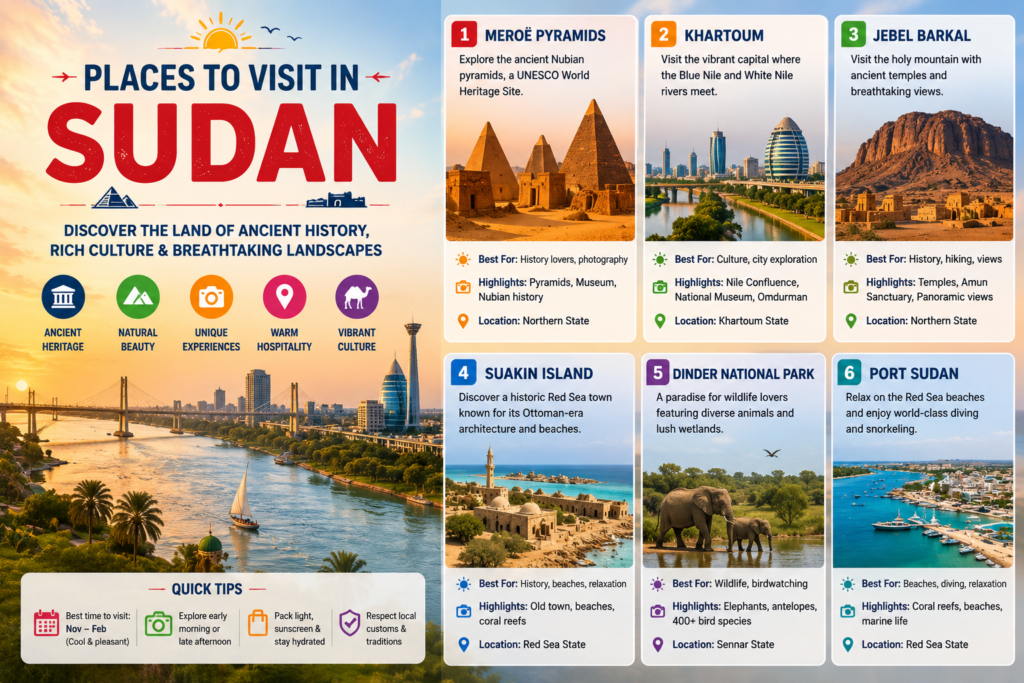
Sudan is not a conventional tourist destination, and the current security situation requires careful research before planning any trip, but for the small number of travellers who do make it, the Sudan tourist attractions on offer are genuinely world-class and almost entirely uncrowded.
Top Places to Visit in Sudan Africa (Quick Overview)
Sudan has more ancient pyramids than Egypt, built by the Nubian kingdoms of Kush, Meroë, and Napata that ruled for centuries alongside and sometimes over ancient Egypt itself. The civilisation that built these structures was sophisticated, powerful, and extraordinarily well-documented archaeologically, yet almost completely unknown to most international travellers. Here are some top places to visit in Sudan, Africa. Have a quick look at these:
| Destination | Region | Best For | Practical Notes |
| Meroë Pyramids | Northern Sudan | Ancient pyramids, desert scenery | Most accessible major site |
| Khartoum | Central | History, museums, Nile confluence | Main entry point |
| Nubian Villages | Far North | Culture, Nile scenery, hospitality | Requires time and planning |
| Jebel Barkal | Northern Sudan | Temples, sacred mountain, history | Near Karima town |
| Kerma | Northern Sudan | Oldest sub-Saharan city ruins | Combine with Nubian circuit |
Meroë Pyramids: The Most Famous Sudan Tourist Attraction
The Meroë Pyramids are the single most important of all places to visit in Sudan Africa, built between approximately 300 BC and 350 AD as royal tombs for the kings and queens of the Kushite kingdom of Meroë.
- The pyramids are steeper and narrower than their Egyptian counterparts. The royal cemetery divides into three distinct groups: the South Cemetery (the oldest and most complete), the North Cemetery (the most photographed, with the largest concentration of well-preserved pyramids on a single ridge), and the West Cemetery.
- Standing in the North Cemetery at dawn as the sun rises over the desert and lights the pyramid faces is one of the most extraordinary Sudan places to see experiences. The combination of monumental ancient architecture and completely empty desert landscape creates an atmosphere that famous Egyptian sites, surrounded by crowds and tourist infrastructure, can no longer offer.
Meroë is located approximately 200km north of Khartoum on the eastern Nile bank accessible by road in 3–4 hours or by a combination of train and local transport. Basic guesthouses operate in the nearby village of Bagrawiyah.
Khartoum: What to See and Do in Sudan’s Capital
Khartoum is the capital and main entry point for any places to visit in Sudan itinerary. It is a city built at the confluence of the Blue Nile (flowing from Ethiopia) and the White Nile (flowing from Uganda), a geographical feature that has defined the city’s strategic importance for millennia.
- The National Museum of Sudan in central Khartoum is the essential starting point for understanding the country’s extraordinary history. The collection covers Nubian civilisation from prehistoric times through the Meroitic, Kushite, and Christian-era kingdoms, with rescued temple reliefs from sites flooded by the Aswan Dam among the most significant exhibits. It’s the best single introduction to Sudan tourist attractions available in the country.
- The confluence viewpoint is where the distinctly different-coloured waters of the Blue and White Nile visibly merge. It is one of the most distinctive fun things in Sudan’s natural sights, best seen from a boat or the Tuti Island bridge.
- The Omdurman Souq across the Nile from central Khartoum is one of the largest traditional markets in Africa gold merchants, spice sellers, fabric traders, and food vendors spread across a network of covered and open-air lanes that is genuinely absorbing for an afternoon of browsing and people-watching.
Nubian Villages: Cultural Places to See in Sudan
The Nubian villages strung along the Nile between Khartoum and the Egyptian border represent the living cultural heritage of a people whose civilisation predates most of the ancient world. They are among the most rewarding Sudan places to see for travellers interested in culture and hospitality over pure archaeology.
- Nubian villages are characterised by colourfully painted mudbrick houses, elaborate doorway decorations, and a tradition of hospitality toward visitors that makes the experience of staying in a family guesthouse in a village like Karima or Old Dongola genuinely memorable.
- The village of Abri in the far north has a concentration of traditional Nubian architecture that survived the flooding of Lake Nasser in the 1960s many Nubian communities were displaced southward by the dam’s reservoir and their original villages submerged. What remains north of the lake retains an authenticity that more developed destinations in the region have lost.
Jebel Barkal: Ancient Temples and Pyramid Sites in Sudan
Jebel Barkal is a flat-topped sandstone mesa rising abruptly from the desert near the town of Karima. It was considered sacred by both ancient Egyptians and Nubian Kushites as the home of the god Amun.
- The temples carved into its base, and the Napatan pyramids on the surrounding plain, constitute one of the most dramatically sited archaeological complexes in Africa the mesa itself, with its distinctive pinnacle, is visible from the pyramid field and provides a backdrop that Meroë’s open desert doesn’t offer.
- The Amun Temple at Jebel Barkal’s base retains painted relief carvings of remarkable quality and colour. The pyramid field across the plain covers several Kushite royal burial sites from a different period than Meroë. Combined with the Meroë pyramids and the Nubian village circuit, Jebel Barkal makes the northern Sudan itinerary one of the most archaeologically compelling places to visit in Sudan Africa routes on the continent.
Kerma: One of the Oldest Historical Places to Visit in Sudan
Kerma, near the modern town of the same name in northern Sudan, is the oldest known sub-Saharan African city, occupied continuously from approximately 2500 BC and capital of the Kingdom of Kerma, one of the earliest sophisticated states in Africa south of the Sahara.
- The Western Deffufa is a massive mudbrick temple complex rising from the flat plain. It is the most significant surviving structure of the ancient city and one of the largest mudbrick buildings in Africa. The scale and construction quality, achieved without stone tools, are extraordinary.
- The Museum of Kerma nearby covers the excavations comprehensively and is one of the best small archaeological museums among all Sudan tourist destinations.
What Can You Do in Sudan? Top Experiences & Fun Things
The answer is genuinely limited compared to conventional tourist destinations; infrastructure is minimal outside Khartoum, tourism services are basic, and the ongoing security situation in several regions of the country requires serious advance research and up-to-date government travel advice before any visit.
What Sudan offers in exchange for that effort is something increasingly rare in international travel:
- Visit Nubian pyramids or ancient world-class sites without crowds,
- Explore Nile-side villages, a hospitality culture among some of the warmest in Africa
- A desert landscape of extraordinary visual drama that makes even the journey between sites memorable.
- Shop in Omdurman Souq and see the Blue & White Nile confluence
Important note: Sudan has experienced significant political instability and conflict since 2019, with serious ongoing security concerns in multiple regions as of 2025. Check your government’s current travel advisory before planning any trip to Sudan. This guide covers the Sudan tourist destinations for informational and planning purposes.
Sudan Travel Guide: Entry, Transport, Safety & Best Time to Visit
- Entry: Most nationalities require a visa to enter Sudan, so apply through the Sudanese embassy in advance. Requirements have changed frequently in recent years; check current regulations carefully.
- Getting around: Domestic travel in Sudan is challenging as roads outside Khartoum range from reasonable to very poor, public transport is limited, and many sites require private vehicle hire with a local guide or through a specialist tour operator. The northern Nile route (Khartoum to Meroë to Jebel Barkal to Kerma) is the most established tourist circuit and the most logistically manageable.
- Best time to visit: October through March is the only practical window for northern Sudan, as temperatures during this period are 20–30°C. April through September sees temperatures regularly exceeding 40°C in the desert regions, making outdoor archaeological site visits genuinely dangerous.
- Specialist tour operators: Given the infrastructure challenges and security complexity of Sudan travel, using a specialist operator with current on-the-ground knowledge is strongly recommended over independent travel. Several operators in Egypt and Europe offer northern Sudan archaeology tours that include the main Meroë-Jebel Barkal-Kerma circuit.
- Currency: The Sudanese pound is the official currency. US dollars are widely accepted and often preferred at tourist sites and hotels. ATM availability outside Khartoum is very limited; carry sufficient cash.
Before finalising your itinerary, compare routes and check for any current offer on international flights, especially if you’re flying via Cairo or Addis Ababa, which are the most common transit hubs for Sudan.
FAQs About Visiting Sudan
The Meroë Pyramids, Jebel Barkal, the Nubian villages of the north, and the National Museum of Sudan in Khartoum are the four Sudan tourist attractions that constitute the essential Sudan itinerary. All four are accessible on the northern Nile circuit that most specialist tours follow.
Sudan’s security situation is complex and has changed significantly since 2019. Several regions have active conflict advisories. The northern archaeological circuit (Khartoum, Meroë, Karima) has historically been the most accessible for visitors, but current conditions require checking your government’s latest travel advisory before making any plans.
The Nubian pyramid fields are more numerous than Egypt’s, and the ancient Kushite and Meroitic kingdoms that built them are Sudan’s most significant historical contribution to world heritage. The country’s role as the heartland of Nubian civilisation, largely overlooked in mainstream historical narratives, is increasingly recognised by archaeologists and historians.
October through March is the only practical window as temperatures are manageable in this period across the northern desert regions where the main places to visit in Sudan Africa are located. The summer months are dangerously hot for outdoor travel.