
The places to visit in Bangkok include ancient temples, floating markets, bars on rooftops, delicious street food, and a shopping experience which is among the busiest in South East Asia, all wrapped up in a city which runs on its own rhythm. The tourist attractions in Bangkok are extremely diverse considering it is only one city, and the most exciting travel plans will combine the most popular attractions with the less well-known parts of the city, which can really get you addicted to visiting the city again and again.
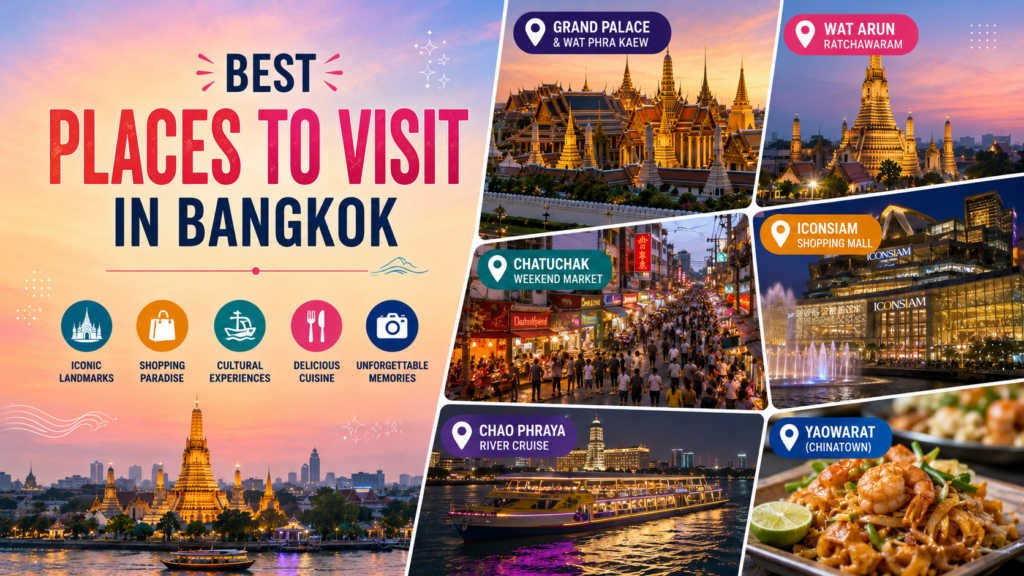
Here’s everything that you should know about the tourist places to visit in Bangkok.
Top Tourist Places to Visit in Bangkok Thailand (Quick Overview)
| Destination | Area | Best For | Approximate Cost |
| Grand Palace and Wat Phra Kaew | Rattanakosin | History, architecture, culture | THB 500 |
| Wat Pho | Rattanakosin | Reclining Buddha, massage school | THB 200 |
| Wat Arun | Thonburi | Temple, river views, photography | THB 100 |
| Chatuchak Weekend Market | Northern Bangkok | Shopping, food, atmosphere | Free entry |
| Chinatown (Yaowarat) | Central | Street food, gold shops, energy | Free |
| Chao Phraya River | City-wide | Temples, local life, scenery | THB 15–30 ferry |
| Jim Thompson House | Pathumwan | Architecture, silk, culture | THB 200 |
| Damnoen Saduak | 80km south | Floating market, local life | Day trip |
Grand Palace & Wat Phra Kaew: Must-Visit Tourist Sites in Bangkok Thailand
- The Grand Palace is the single most important of all tourist sites in Bangkok Thailand. It consists of a vast complex of royal halls, pavilions, and ceremonial buildings enclosed within high white walls in the Rattanakosin historic district. Built in 1782 as the official residence of the Thai royal family, the palace compound covers 218,000 square metres and represents the most concentrated expression of traditional Thai architecture in the country.
- Within the Grand Palace complex, Wat Phra Kaew (the Temple of the Emerald Buddha) is the most sacred Buddhist temple in Thailand, housing a 66cm jasper Buddha image dressed in seasonal gold robes changed three times a year by the Thai king in a ceremony closed to the public. The temple complex surrounding the image is decorated with extraordinary detail, like golden chedis, intricately painted murals covering the entire inner wall of the compound depicting the Ramakien epic, and guardian statues of towering half-human, half-giant yaksha demons at every entrance.
Practical notes: Dress code is strictly enforced — shoulders and knees must be covered (sarongs are available to borrow at the entrance). Arrive at opening time (8:30 am) to beat the tour groups. Allow 2–3 hours minimum for the full complex. The THB 500 entry fee is the highest of any places in Bangkok, but fully justified by the scale and quality of what’s inside.
Wat Pho & Wat Arun: Iconic Bangkok Tourist Spots You Should Not Miss
Wat Pho is one of the oldest and largest temple complexes in Bangkok and home to the Reclining Buddha: a 46-metre-long, 15-metre-high gilded statue of the Buddha entering nirvana, housed in a building barely large enough to contain it. The statue’s mother-of-pearl inlaid feet alone are 3 metres tall. It is a 10-minute walk from the Grand Palace.
- Beyond the Reclining Buddha, Wat Pho is the national centre for traditional Thai massage. The massage school within the temple complex is one of the most respected in the country. A one-hour traditional Thai massage at the temple costs approximately THB 420 and is one of the best Bangkok places to see and experience that combines culture with genuine physical benefit.
- Wat Arun (Temple of Dawn) sits directly across the Chao Phraya River — a short ferry crossing from Wat Pho’s pier. The temple’s central prang (tower) rises 70 metres and is covered entirely in fragments of Chinese porcelain and coloured glass arranged in intricate floral patterns, a mosaic effect that catches the light differently at every hour of the day. Climbing the steep steps of the central prang gives the best river view of any tourist places in Bangkok Thailand site. Visit at sunset when the tower glows in the low afternoon light. It is one of the most photographed Bangkok tourist spots images in the city.
Chatuchak Market: One of the Best Places to Visit in Bangkok for Shopping
Chatuchak Weekend Market (JJ Market) in northern Bangkok is one of the largest weekend markets in the world, with 15,000 stalls covering 35 acres, open every Saturday and Sunday from 9 am to 6 pm. It’s one of the places to visit in Bangkok Thailand that most visitors underestimate in terms of time — plan a minimum of four hours, ideally more.
- The market is divided into sections by category, like antiques, clothing, plants, pets, home furnishings, street food, vintage goods, and handicrafts each have their own zone mapped on the entrance boards.
- The antiques and collectables section (Section 1) is excellent for genuine Thai ceramics, old Buddha images, and vintage textiles.
- The street food in the central sections covers some of the best cheap eating in Bangkok — pad thai, mango sticky rice, freshly pressed sugarcane juice, and grilled satay, all available for THB 40–80 per portion.
Go early — by midday, the market is genuinely hot and very crowded. The BTS Skytrain (Mo Chit station) and MRT (Chatuchak Park station) both connect directly.
Chinatown (Yaowarat): Top Places of Interest in Bangkok for Food Lovers
Yaowarat (Bangkok’s Chinatown) is the most atmospheric of all places of interest in Bangkok for food lovers and one of the oldest districts in the city, established when Bangkok’s original Chinese merchant community settled along the Chao Phraya River in the late 18th century. The main Yaowarat Road and its surrounding lanes constitute one of the best street food environments in Southeast Asia.
- The food culture here is distinct from the rest of Bangkok. The roast duck hanging in shop windows, dim sum trolleys pushing through narrow alleys, fresh seafood on ice outside restaurants with plastic chairs spilling onto the pavement, and the famous t-bone crab and oyster omelette vendors that draw Bangkok locals specifically to Yaowarat on weekend evenings.
- The gold shops along Yaowarat Road, displaying enormous quantities of 23-carat gold jewellery in illuminated windows, give the street its characteristic golden light after dark and are genuinely worth walking even for visitors with no intention of buying.
- The Wat Traimit temple at the eastern end of Yaowarat houses the world’s largest solid gold Buddha statue (5.5 tonnes, 3 metres tall). It is one of the most significant tourist sites in Bangkok Thailand.
Chao Phraya River: Scenic Places to See in Bangkok from the Water
The Chao Phraya River running through the centre of Bangkok is the city’s most important artery, and using the public river ferry (Chao Phraya Express Boat) is one of the best ways to see the places to visit in Bangkok along both banks efficiently and cheaply.
- The orange flag express boats run the full length of the river from Nonthaburi in the north to Wat Rajsingkorn in the south — THB 15–30 per journey depending on distance. The riverside scenery covers temple spires, traditional wooden houses on stilts, luxury hotels, and the constant traffic of rice barges, longtail boats, and tourist ferries that defines Bangkok’s waterfront character.
- The Asiatique The Riverfront is an open-air night market and entertainment complex in a converted early 20th-century dockland — it is one of the best Bangkok tourist spots and a riverside evening destination. Accessible by free shuttle boat from Saphan Taksin BTS station, it combines shopping, food, and a giant Ferris wheel with the river as a backdrop.
- Longtail boat tours through the Bangkok Noi canal network on the Thonburi side of the river give access to wooden temple communities, orchid farms, and riverside life that has changed little in decades. It is one of the most distinctive places in Bangkok for visitors who want to see beyond the modern city.
Sukhumvit & Silom: Modern Places in Bangkok for Food, Nightlife & Culture
Sukhumvit is Bangkok’s most international neighbourhood. It is a long boulevard stretching east from the city centre with the BTS Skytrain running its length, connecting dozens of sub-neighbourhoods each with its own character.
- Thong Lor and Ekkamai (Sukhumvit Sois 55 and 63) have the city’s best independent restaurants, rooftop bars, and boutique shopping, the area where Bangkok’s young creative class eats, drinks, and works.
- Silom is the financial district by day and one of the city’s best evening food and entertainment strips by night.
- Patpong Night Market runs along the infamous entertainment street and is excellent for browsing regardless of the surrounding context — fake goods, street food, and the compressed energy of Bangkok nightlife in full operation.
- Lumphini Park at the northern end of Silom (Bangkok’s largest central park) is the city’s best morning destination: monitor lizards sunbathing by the lake, groups doing tai chi on the grass, and joggers circling the paths at dawn create a genuinely peaceful counterpoint to Bangkok’s relentless urban energy.
Jim Thompson House & Cultural Attractions in Bangkok Thailand
Jim Thompson House in the Pathumwan neighbourhood is one of the most distinctive tourist places in Bangkok Thailand, for architecture and cultural history, the former residence of the American businessman who revived the Thai silk industry after WWII, built from six traditional Thai teak houses assembled on a canal bank and filled with his collection of Asian art, antiques, and textiles.
- The guided tour (mandatory, THB 200) covers the history of Thompson’s extraordinary career and his mysterious 1967 disappearance in the Cameron Highlands of Malaysia. It is a story that remains unsolved and adds a compelling narrative layer to what is already a beautiful property.
- The adjacent Jim Thompson Silk Shop is the best place in Bangkok to buy quality Thai silk. It is expensive by street market standards but authentically produced and impeccably finished.
- The nearby Bangkok Art and Culture Centre (BACC) at the Siam BTS intersection is the best contemporary art venue in the city — free to enter, covering Thai and international contemporary art across multiple floors of a striking circular building.
Best Day Trips from Bangkok (Floating Markets & Ayutthaya)
Damnoen Saduak Floating Market (80km south of Bangkok) is the most famous of all Bangkok day trips and one of the most visited tourist places to visit in Bangkok region.
- Vendors in wooden boats selling tropical fruits, pad thai, and Thai sweets navigate narrow canals between wooden shophouses in a scene that has characterised the Thai waterway market tradition for centuries.
- Go early — the market operates from 7 am, and the best atmosphere is before 9 am when the light is low, and the crowds are manageable. Most Bangkok hotels can arrange day trip transport.
- Ayutthaya (80km north, accessible by train in 1.5 hours) is the ruined capital of the ancient Kingdom of Ayutthaya, sacked by the Burmese in 1767. The ruins of over 400 temples and royal palaces spread across an island in the Chao Phraya River constitute one of the most historically significant tourist sites in Bangkok Thailand, a day trip destination. The headless Buddha statues and the famous tree-encased Buddha head at Wat Mahathat are among the most distinctive archaeological images in Southeast Asia.
For a broader picture of Thailand travel, our guides on places to go in Thailand and best Asian countries to travel to cover the country in full context.
Practical Travel Tips for Visiting Bangkok Thailand
- Getting around: The BTS Skytrain and MRT Metro cover the main tourist areas efficiently — a Rabbit Card (BTS stored value card) simplifies multiple journeys. Taxis are metered and cheap; always insist on the meter. Tuk-tuks are atmospheric but overpriced for longer journeys.
- Best time to visit: November through February is the coolest and driest window — 25–32°C with low humidity. March through May is intensely hot (35–38°C). June through October is the wet season — daily rain but very manageable with afternoon showers rather than all-day rain.
- Budget: Bangkok is an excellent value. Mid-range accommodation runs THB 800–2,500 (€20–65) per night. Street food meals cost THB 40–80 (€1–2). Sit-down restaurants at good mid-range establishments run THB 200–500 (€5–13) per person.
- Dress code: Shoulders and knees covered for all temple visits — carry a lightweight scarf as a versatile cover-up for spontaneous temple stops.
- Language: Thai is the official language — English is widely spoken in tourist areas, less so in local markets and residential neighbourhoods.
FAQs About Places to Visit in Bangkok Thailand
Three to four days covers the essential places to visit in Bangkok — Grand Palace, Wat Pho, Wat Arun, Chinatown, Chatuchak (if visiting on a weekend), and at least one evening exploring Sukhumvit or Silom. Five days add Ayutthaya and the floating market day trips comfortably.
The Grand Palace and Wat Phra Kaew, the street food culture, the Chao Phraya River temples, Chatuchak Market, and the city’s extraordinary nightlife are the five things Bangkok is most internationally associated with as a destination.
Yes, Bangkok is one of the safest major cities in Southeast Asia for international visitors. Standard urban awareness applies — watch for tuk-tuk scams (offers to take you to a “special” gem shop or tailor), keep valuables secure in crowded markets, and use metered taxis rather than unlicensed vehicles.
Sukhumvit (Asok to Thong Lor) suits most first-time visitors — central, well-connected by BTS, and surrounded by good restaurants and amenities. Silom is better for business travellers and those wanting proximity to the river. The Rattanakosin historic district puts you closest to the temples but has fewer accommodation options.
November through February is the best time to visit Bangkok — cool, dry, and comfortable for walking between Bangkok tourist spots without the March–May heat or the wet season afternoon downpours of June through October.