
The places to visit in Nepal extend far beyond the Everest Base Camp trek that dominates most people’s mental image of the country. Nepal packs an extraordinary range into a relatively small geography — Himalayan peaks, medieval temple cities, jungle wildlife reserves, and a cultural depth shaped by centuries of Hindu and Buddhist tradition. Whether you’re a serious trekker, a first-time Asia traveller, or somewhere in between, Nepal delivers an experience that is genuinely difficult to find anywhere else.
Here’s a full destination breakdown of the Nepal tourist places worth building your trip around.
Top Places to Visit in Nepal: Quick Overview
| Destination | Region | Best For | Best Time to Visit |
| Kathmandu | Central | History, temples, culture | Oct–Nov, March–May |
| Pokhara | Western | Lakes, views, trekking base | Oct–Nov, March–May |
| Everest Region | Northeast | World’s most famous trek | Oct–Nov, March–May |
| Annapurna Region | Central-West | Trekking, diversity, villages | Oct–Nov, March–May |
| Chitwan | Southern Terai | Wildlife, jungle safari | Oct–April |
| Lumbini | Southern Terai | Buddhist pilgrimage, history | Oct–March |
| Bhaktapur | Kathmandu Valley | Medieval architecture, culture | Year-round |
| Mustang | Northern | Remote landscapes, Tibetan culture | May–October |
Kathmandu: Top Places to Visit in Nepal for Culture and History
Kathmandu is the entry point for almost every travel destination in Nepal. It rewards visitors who give it more than a single transit day. The city is chaotic, dusty, and loud in a way that takes adjustment, but the cultural and historical depth packed into the Kathmandu Valley is extraordinary.
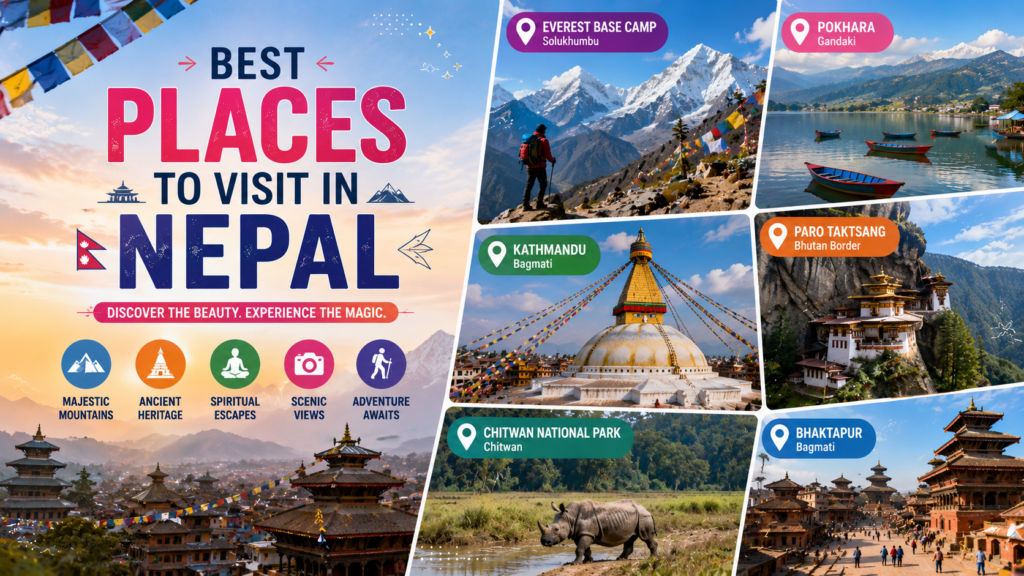
- Durbar Square (actually three separate Durbar Squares across the valley in Kathmandu, Patan, and Bhaktapur) is the historic palace complex that formed the centre of power for Nepal’s medieval kingdoms. The Kathmandu Durbar Square has the Kumari Chowk, home to the living goddess Kumari, a young girl selected through an elaborate religious process to serve as a divine representative until puberty. Seeing the Kumari appear briefly at her window is one of the most culturally distinctive Nepal sightseeing places experienced in the country.
- Boudhanath Stupa is the largest Buddhist stupa in Nepal and one of the most important pilgrimage sites in Asia. A vast white dome topped with the painted eyes of the Buddha, encircled by a cobblestoned plaza lined with monasteries, prayer wheel corridors, and Tibetan tea shops. Walking the circumambulation path (kora) around the stupa with monks and pilgrims is one of the most atmospheric places of interest in Nepal available to any visitor.
- Pashupatinath Temple on the Bagmati River is the most sacred Hindu temple in Nepal. The open-air cremation ghats on the riverbank, where funeral pyres burn continuously, are one of the most profound and confronting places to explore in Nepal for first-time visitors. Non-Hindus cannot enter the main temple but can observe from the opposite bank.
- Swayambhunath (the Monkey Temple) is the most iconic image of the city and one of the essential Nepal tourism places to visit on any Kathmandu itinerary. It is a hilltop stupa complex reached by 365 steps, surrounded by resident monkeys and giving panoramic views over Kathmandu Valley.
Pokhara: One of the Best Places in Nepal to Go for Nature and Adventure
Pokhara is the most beautiful and most relaxed of all the places in Nepal to go. It is a lakeside city with the Annapurna massif as its backdrop, combining a genuine outdoor adventure base with cafés, restaurants, and a waterfront atmosphere that makes it one of the easiest places to visit in Nepal to decompress after a long trek.
- Pokhara is the base for paragliding over the Phewa Lake valley, making it one of the most popular Nepal tourist places for adventure activities and the best way to see the city and its mountain backdrop from above.
- Phewa Lake in the centre of Pokhara reflects the Annapurna range and the white spire of Machhapuchhre (Fishtail Mountain, 6,993 metres) on still mornings — one of the most photographed Nepal sightseeing places images in the country. Renting a rowboat on the lake for an early morning hour and drifting toward the reflection of the mountains is one of the most quietly extraordinary experiences Nepal offers.
- Sarangkot above the city is the best viewpoint for the Himalayan sunrise, with a 45-minute hike or a short taxi ride to a ridge above Pokhara, which gives 180-degree views of the Annapurna range at dawn. The Annapurna South, Machhapuchhre, Dhaulagiri, and on clear days the distant Manaslu are all visible — a panorama of 7,000 and 8,000-metre peaks at first light that is genuinely difficult to process in scale.
Everest Region: Most Famous Places to Explore in Nepal
The Everest Base Camp trek is the most famous of all places to explore in Nepal. A 12–14 day return journey from Lukla airport through Sherpa villages, Buddhist monasteries, and high-altitude glacial moraines to the base of the world’s tallest mountain at 5,364 metres.
The trek is not technically difficult, no climbing skills required, but it is physically demanding. Altitude acclimatisation is the primary challenge: proper acclimatisation days (at Namche Bazaar and Dingboche) are non-negotiable for avoiding serious altitude sickness. The route passes through Namche Bazaar (the main Sherpa market town and the most complete mountain village in the Himalayas), Tengboche Monastery (the most important monastery in the Everest region, set in a meadow with Ama Dablam behind it), and Gorak Shep before the final walk to Base Camp.
- The Kala Patthar viewpoint (5,545 metres) above Gorak Shep gives the best direct view of Everest’s summit. The Base Camp itself sits in a glacial hollow where the mountain is not directly visible. Most trekkers summit Kala Patthar at pre-dawn for the sunrise view.
- The Three Passes Trek is a more demanding circuit through the Everest region, crossing three high passes (Kongma La, Cho La, Renjo La). It is the best travel destination in Nepal for experienced trekkers wanting to see the full scope of the Khumbu region beyond the Base Camp route.
Best time for trekking in Nepal: October to November and March to May are the two trekking windows with clear skies, stable trails, and visibility that make every step worthwhile. Monsoon (June–September) and winter (December–February) make high-altitude trekking impractical or dangerous.
Annapurna Region: Best Nepal Tourism Places to Visit for Trekking
The Annapurna Circuit is another great Nepal tourism places to visit for trekking experience — a 15–20 day loop through a greater variety of landscapes, cultures, and ecosystems than the Everest region covers. The route climbs from subtropical forest through alpine meadows to the Thorong La Pass (5,416 metres) (the highest point of the circuit) before descending into the rain-shadow landscape of Mustang.
- Poon Hill (3,210 metres) above the village of Ghorepani is the most accessible Annapurna viewpoint — a 2–3 day trek from Pokhara gives one of the most celebrated Himalayan sunrise panoramas in Nepal without the full circuit commitment. It’s one of the best places in Nepal to go for trekkers with a week or less available.
- The Annapurna Base Camp trek (7–10 days from Pokhara) follows a different route into the heart of the Annapurna massif, arriving at a glacial amphitheatre completely enclosed by 7,000 and 8,000-metre peaks, including Annapurna I (8,091 metres), the tenth-highest mountain in the world.
Chitwan National Park: Wildlife and Jungle Nepal
Chitwan National Park in the southern Terai lowlands is one of the most important Nepal tourist places, a wildlife destination, and a UNESCO World Heritage Site covering 952 square kilometres of subtropical jungle, grassland, and riverine forest that is home to one-horned rhinoceroses, Bengal tigers, gharial crocodiles, and over 600 bird species.
- Jeep safaris into the park give the best access to open grassland areas where rhino sightings are frequent, one of the highest rhino densities in Asia. Elephant-back safaris were historically the most popular activity but are now controversial due to animal welfare concerns; jeep and walking safaris with trained naturalist guides are the responsible alternatives.
- Canoe trips on the Rapti River at dawn, drifting silently past gharial crocodiles basking on the banks and kingfishers darting between the reeds. These are one of the most peaceful and distinctive places of interest in Nepal experiences outside the mountains.
Best time to visit: October through April is the best window for the dry season in the Terai, cooler temperatures, and vegetation that has thinned enough to improve wildlife visibility.
Lumbini: Spiritual Nepal Sightseeing Place and Birthplace of Buddha
Lumbini in the southwestern Terai is one of the most significant Nepal sightseeing places for Buddhist pilgrims and culturally curious travellers alike. It is the birthplace of Siddhartha Gautama (the Buddha), marked by the Maya Devi Temple built around the precise spot identified by archaeological excavation as his birth site.
- The surrounding Sacred Garden contains the Ashoka Pillar — erected by the Indian emperor Ashoka in 249 BC after his pilgrimage to the site, one of the oldest dated monuments in South Asia.
- The broader Lumbini development zone has dozens of monasteries built by Buddhist nations from across the world, including Japanese, Thai, Chinese, Korean, Sri Lankan, and Tibetan monastery complexes, creating an extraordinary architectural landscape across several square kilometres.
- Lumbini is relatively straightforward to reach from Pokhara (4–5 hours by road) and adds a dimension to any Nepal itinerary that the mountains alone don’t cover.
Bhaktapur: Best-Preserved Cultural Places to Explore in Nepal
Bhaktapur in the Kathmandu Valley (13km east of Kathmandu city centre) is the best preserved of the three medieval Newar kingdoms and one of the finest places to explore in Nepal for architecture and craftsmanship.
- The Durbar Square, Taumadhi Square (home to the five-storey Nyatapola Temple, the tallest traditional temple in Nepal), and the Pottery Square, where potters still work with wheels, constitute a living medieval urban environment that survived the 2015 earthquake considerably better than Kathmandu’s squares.
- The 55-Window Palace is a medieval royal palace with 55 intricately carved wooden windows overlooking the Durbar Square. It is the finest example of Newar woodcarving in the valley. The National Art Museum within the palace complex covers Newar painting and metalwork comprehensively.
Bhaktapur is best visited as an overnight stay rather than a day trip from Kathmandu. The city after the day visitors leave becomes quieter, more atmospheric, and significantly more authentic.
Nepal Travel Guide: Essential Information for First-Time Visitors
- Getting there: Most international visitors fly into Tribhuvan International Airport in Kathmandu, making it one of the most scenically dramatic airport approaches in the world, descending between Himalayan peaks into the valley.
- Early Booking: Lukla airport (for Everest treks) is served by small domestic aircraft from Kathmandu — book these flights as early as possible, particularly for October and November.
- Visa: Most nationalities can obtain a tourist visa on arrival at Kathmandu airport — 15 days ($30), 30 days ($50), or 90 days ($125). Bring USD cash and a passport photo.
- Budget: Nepal is one of the most affordable travel destination in Nepal in Asia. Mid-range accommodation in Kathmandu and Pokhara runs NPR 2,000–5,000 (€14–35) per night. Trekking tea house accommodation on the Everest and Annapurna routes runs NPR 500–1,500 (€3–10) per night. A full meal at a good local restaurant costs NPR 400–800 (€3–6).
- Trekking permits: The TIMS card (Trekkers’ Information Management System) and national park entry permits are required for all major treks — available in Kathmandu and Pokhara. The Everest region requires an additional Sagarmatha National Park permit. Costs are modest, and the process is straightforward through registered trekking agencies.
- Best time to visit: October to November is the most popular window for post-monsoon clear skies, stable weather, and the best mountain visibility of the year. March to May is the spring window with warmer, rhododendron (name of flower) blooms on lower trekking routes.
Best Time to Visit Nepal for Different Travel Experiences
The best time to visit Nepal depends on what you want from your trip. For clear mountain views and trekking, October to November is ideal. March to May brings warmer weather and blooming rhododendrons, perfect for nature lovers. Winter (December to February) is quieter but colder, especially in the mountains, while the monsoon season (June to September) offers lush landscapes, fewer crowds, and lower prices, but limited visibility. Choose your season based on whether you prioritise views, budget, or crowd levels.
Frequently Asked Questions About Places to Visit in Nepal
Kathmandu (Boudhanath, Pashupatinath, Swayambhunath), Pokhara (Phewa Lake, Sarangkot sunrise), and either the Everest or Annapurna region for trekking cover the essential places to visit in Nepal for a first trip. Add Chitwan for wildlife if the itinerary allows.
Two weeks covers Kathmandu (3 nights), Pokhara (2 nights), a shorter trek like Poon Hill or Annapurna Base Camp (7–8 days), and Chitwan (2 nights) comfortably. Three weeks allow the full Everest Base Camp or Annapurna Circuit trek with cultural stops.
Yes, Nepal is one of the safest countries in Asia for solo travellers, including solo female travellers on the main trekking routes. The trekking infrastructure is well-developed, trail conditions are clearly marked, and tea house owners and fellow trekkers create a genuine community on the popular routes.
The Poon Hill trek (3–4 days from Pokhara) is the most recommended Nepal tourism places to visit, a trekking option for beginners with manageable altitude, well-maintained trails, good tea house infrastructure, and the Annapurna sunrise panorama from the top as the payoff.
October and November are the best months overall. The monsoon has cleared, skies are blue, mountain visibility is at its annual best, and all trekking routes are fully operational. March to May is the strong spring alternative with warmer temperatures and rhododendron blooms on lower routes.