

Moldova is the least visited country in Europe, and that’s precisely what makes it extraordinary. The best things to do in Moldova centre around world-record wine cellars, cave monasteries carved into cliffsides, and a Soviet-era breakaway state that exists nowhere else on the continent.
If you want authentic, affordable, crowd-free travel in Europe, Moldova deserves serious attention.
Quick Overview of Top Attractions in Moldova
| Destination | Best For | Approximate Cost |
| Chișinău | Soviet architecture, wine bars, food | Low |
| Cricova Winery | Underground wine city, tastings | €15–30 |
| Mileștii Mici | World’s largest wine collection | €10–20 |
| Orheiul Vechi | Cave monastery, dramatic landscape | Free–€5 |
| Transnistria | Soviet relics, unique breakaway state | Free |
| Soroca | Medieval fortress, Roma architecture | Low |
Why Moldova Should Be on Your Travel Bucket List
Moldova sits between Romania and Ukraine. It is small, landlocked, and consistently overlooked. Most travellers pass it by entirely. That’s a mistake.
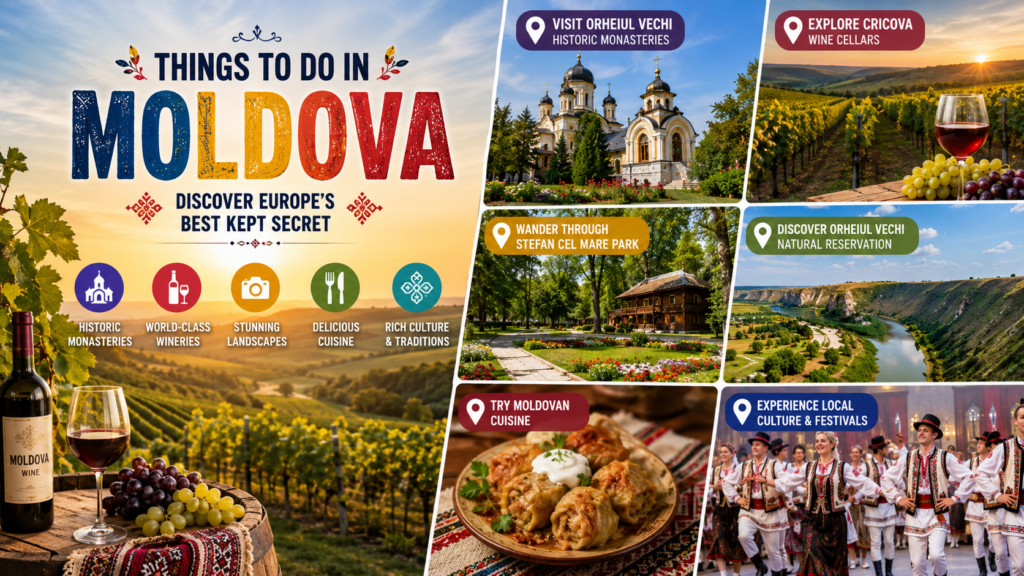
The country has more wineries per square kilometre than anywhere else in the world. It has a cave monastery that rivals anything in the Balkans. It has a breakaway Soviet territory with its own currency and military that hasn’t been recognised by a single UN member state in over 30 years.
Moldova tourist attractions aren’t polished or commercialised. That’s the whole point.
Best Things to Do in Moldova (Top Places to Visit)
- Chișinău – Capital City & Cultural Hub
Chișinău (pronounced Kish-i-now) is Moldova’s capital — rebuilt almost entirely after WWII bombing, which gives it wide Soviet-era boulevards, Stalinist architecture, and a distinctly Eastern European character unlike any Western city.
What to do in Chișinău:
Central Market Experience
The Central Market (Piața Centrală) is the best first stop. It is a vast covered market selling produce, dairy, and local goods almost entirely to locals. Moldovan fruit, particularly grapes and plums in season, is extraordinary and costs almost nothing.
Parks and Soviet Architecture
Stefan cel Mare Park running through the city centre is where residents walk and socialise — pleasant, leafy, and lined with Soviet-era monuments that tell the city’s layered story.
Wine Bars in Chișinău
The wine bar scene is the real surprise. Chișinău has more wine bars per capita than almost any European capital. A bottle of excellent Moldovan Fetească Neagră (indigenous red varietal) costs €4–8. Spending an evening working through local wines with Moldovan cheese and cured meats is genuinely one of the best things to do in Moldova for food lovers.
- Cricova Winery – Underground Wine City
Cricova is the most famous of all Moldova tourist attractions — and one of the most unusual wine experiences anywhere in the world.
Built into 120km of underground limestone tunnels beneath the hills north of Chișinău, Cricova maintains a constant 12°C year-round. The result: 1.25 million bottles stored in galleries with their own named streets, a limestone-carved banquet hall, and a tasting room complex used for state occasions.
Yuri Gagarin reportedly celebrated his return from space here. A collection bearing his name still sits in the archive.
Tours include a vehicle ride through the tunnels and structured tastings of Cricova’s sparkling wines (made by the traditional Champagne method) and still reds. Book in advance — weekend tours fill quickly.
Cost: €15–30 depending on the tasting package.
- Mileștii Mici: The World’s Largest Wine Collection
18km south of Chișinău, Mileștii Mici holds the Guinness World Record for the largest wine collection on earth — 1.5 million bottles across 55km of underground galleries.
Where Cricova focuses on sparkling wines, Mileștii Mici specialises in aged still wines. The vintage collection goes back to 1969, and tastings demonstrate how Moldovan Cabernet Sauvignon, Merlot, and Fetească Neagră developed over decades.
The experience is less commercialised than Cricova — it feels like a working winery rather than a tourist attraction, which suits travellers who want authenticity.
Entry and tasting packages: €10–20. Book by appointment.
Combining both wineries in a single day from Chișinău is one of the best things to do in Moldova, providing the most complete picture of Moldovan wine culture available anywhere.
- Orheiul Vechi – Cave Monastery & Scenic Landscapes
Orheiul Vechi (Old Orhei) is the single most visually extraordinary of all attractions in Moldova — 60km north of Chișinău and worth every kilometre.
A complex of cave monasteries, ancient fortifications, and medieval ruins sits carved into a dramatic limestone promontory above a river meander. The site has been occupied for over 6,000 years — Dacians, Romans, Mongols, and medieval Moldavian princes all left traces here.
The Cave Monastery — Orthodox monks carved cells, a church, and living quarters into the cliff face in the 13th century — is the centrepiece. Still active today, it’s one of the most atmospheric and the best places to visit in Moldova.
The cliff-top view over the Răut River curling below is the finest landscape in the country. Full stop.
The village of Butuceni across the valley has guesthouses offering overnight stays with home-cooked Moldovan meals — far better than rushing back to Chișinău.
Getting there: Car or organised day trip only — public transport connections are too infrequent to be practical.
- Transnistria – A Unique Soviet-Era Experience
Transnistria is a self-declared breakaway state on Moldova’s eastern border that declared independence in 1990 — and has operated as a separate de facto country ever since. It has its own currency, military, border controls, and government. No UN member state recognises it.
Visiting is straightforward. A marshrutka (shared minibus) from Chișinău to Tiraspol (the capital) takes 1.5–2 hours. Passport registration at the border checkpoint takes minutes — you receive a migration slip valid for 24 hours.
What you find in Tiraspol:
- Lenin statues still standing in their original positions
- Soviet-era street names unchanged since 1990
- Hammer-and-sickle symbols on government buildings
- A currency featuring an 18th-century Russian general
The Sheriff complex — a private company that effectively runs the Transnistrian economy, owns a football club competing in European competitions, and operates supermarkets and petrol stations across the territory — is one of the most surreal private enterprises in post-Soviet history.
It’s genuinely unlike anywhere else in Europe. That alone makes it one of the best things to do in Moldova for curious travellers.
- Soroca – Fortress & Roma Architecture
Soroca in northern Moldova is worth the three-hour drive from Chișinău for two completely different reasons.
- The Soroca Fortress — a perfectly circular defensive structure with five towers built between 1543 and 1546 by Stephen the Great — is the best-preserved medieval fortress in Moldova. The river views from the ramparts across into Ukraine are excellent attractions in Moldova.
- Above the town, Gypsy Hill (Roma Hill) is something else entirely. Wealthy Roma families built extravagant baroque mansions here in the 1990s and 2000s — columns, towers, domes, gilded facades — using money earned across the former Soviet Union. The result is an architectural landscape that exists nowhere else in Europe.
Best visited as an overnight trip rather than a rushed day return.
Practical Travel Tips for Visiting Moldova
- How to Get to Moldova: Direct flights from London, Paris, Istanbul, and Eastern European hubs via Wizz Air and Air Moldova into Chișinău International Airport
- Getting Around Moldova: Marshrutkas cover regional towns cheaply — car hire gives the most flexibility for Orheiul Vechi and Soroca
- Budget & Costs: One of the cheapest countries in Europe — accommodation €25–50/night, restaurant meals €5–10, wine tastings €10–30
- Language & Currency: Romanian is official — Russian widely spoken, English in tourist facilities. Moldovan leu (MDL) — euros accepted at most tourist sites
- Best Time to Visit Moldova: May–October, with September–October (grape harvest season) the strongest window for wine-focused travel
Frequently Asked Questions About Moldova Travel
Yes, for travellers who value authenticity over infrastructure. The wine culture, cave monastery at Orheiul Vechi, and Transnistria day trip offer experiences genuinely unavailable anywhere else in Europe.
Three to four days cover the essentials, including Chișinău, Cricova or Mileștii Mici, Orheiul Vechi, and Transnistria. Five days adds Soroca comfortably.
Wine, as Moldova has more wineries per capita than any country in the world, with Cricova and Mileștii Mici holding world records for the largest underground wine collections.
Yes, one of the safest countries in Eastern Europe. Transnistria for day-trippers is stable and well-established. Standard travel awareness applies throughout.
September and October for the grape harvest, wine festivals, and excellent autumn weather across the country.